

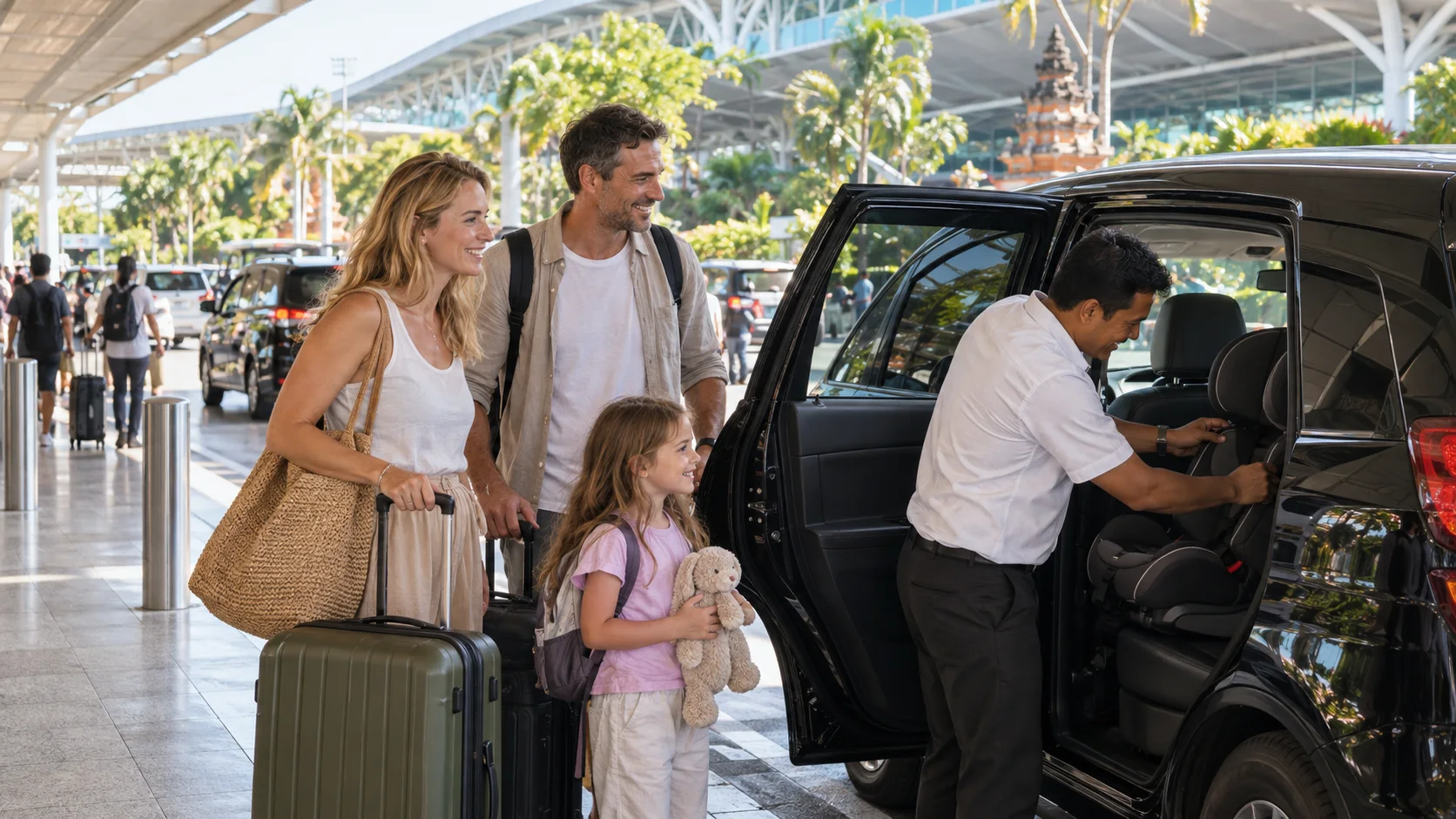
If you are travelling to Bali from Australia during the school holidays, sort out your main transport arrangements before you fly. For families, that usually means confirming the airport pickup, vehicle size, luggage requirements, child-seat requests, and how you will travel between destinations.
The Bali school holiday transport guide Australia travellers need is less about finding one perfect transport option and more about matching each part of the trip to your family’s schedule. June and July can overlap with winter school holidays in several Australian states, while Bali is also entering a generally drier period. Australian school holiday dates vary by state, so check your own school calendar rather than assuming the dates are the same nationwide. For example, in 2026, Queensland and Victoria have winter holidays from late June into July, while NSW has its winter break in July.
For an airport arrival, decide on your pickup method before departure. If you want a pre-arranged private vehicle, you can review the Bali airport transfer for Australian families options and provide your flight, passenger, luggage and destination details when booking.


Why June–July Needs More Transport Planning
Australian winter school holidays do not fall on exactly the same dates across the country. NSW, Victoria, Queensland, South Australia and other states and territories publish their own calendars, so the period when families travel to Bali can extend across several weeks.
That matters because your Bali trip may coincide with other visitors’ holiday periods as well. Transport conditions can change from one day to another depending on traffic, weather, local events, road works and the location of your accommodation.
It is better to treat June and July as a period when advance transport planning is sensible, rather than assuming that every road will be busy or every service will sell out.
Weather is another planning consideration. BMKG’s 2026 climate outlook identified Bali among areas expected to experience lower rainfall during parts of June and July, although actual conditions can still vary.
For families, the practical takeaway is simple: book the services that are important to your itinerary first, then leave flexibility around sightseeing and road travel.
What to plan first
Prioritise these items:
- Airport pickup and return airport transfer
- Correct vehicle size for passengers and luggage
- Child or baby seat requirements
- Hotel and villa addresses
- Inter-island or fast-boat connections
- Full-day driver arrangements for longer sightseeing days
- Departure-day pickup timing
Bali School Holiday Transport Booking Timeline
You do not need to organise every taxi or short journey weeks ahead. Instead, use a staged approach.
6–8 weeks before departure
Start with the parts of the trip that have fixed dates.
Confirm:
- International flight arrival and departure dates
- First accommodation
- Any change of hotel during the trip
- Fast-boat or other onward travel
- Number and ages of children
- Approximate amount of luggage
- Whether you need a baby or child seat
If you are travelling with several family members, this is also a good point to compare vehicle sizes. A car that technically fits everyone may not have enough practical space for suitcases, a stroller and children’s equipment.
3–4 weeks before departure
Finalise your airport transfer and any important longer-distance journeys.
Send the transport provider:
- Flight number
- Arrival date
- Scheduled arrival time
- Number of adults and children
- Child ages
- Luggage requirements
- Child-seat request
- Hotel or villa name
- Full destination address if available
- Contact number or preferred messaging method
This gives the provider enough information to tell you if your requested vehicle or child-seat arrangement needs adjustment.
1 week before departure
Review everything rather than assuming the original booking details are still correct.
Check:
- Flight time
- Accommodation address
- Airport pickup instructions
- Driver contact information
- Meeting point
- Vehicle type
- Child-seat confirmation
- Return transfer date and time
- Any domestic flight or boat connection
If your flight has changed, tell the transport provider rather than relying on the original arrival time.
24–48 hours before travel
Keep your booking confirmation and pickup instructions somewhere accessible on your phone.
It is also worth taking a screenshot in case you have limited mobile data immediately after landing.
Bali Airport Pickup for Australian Families
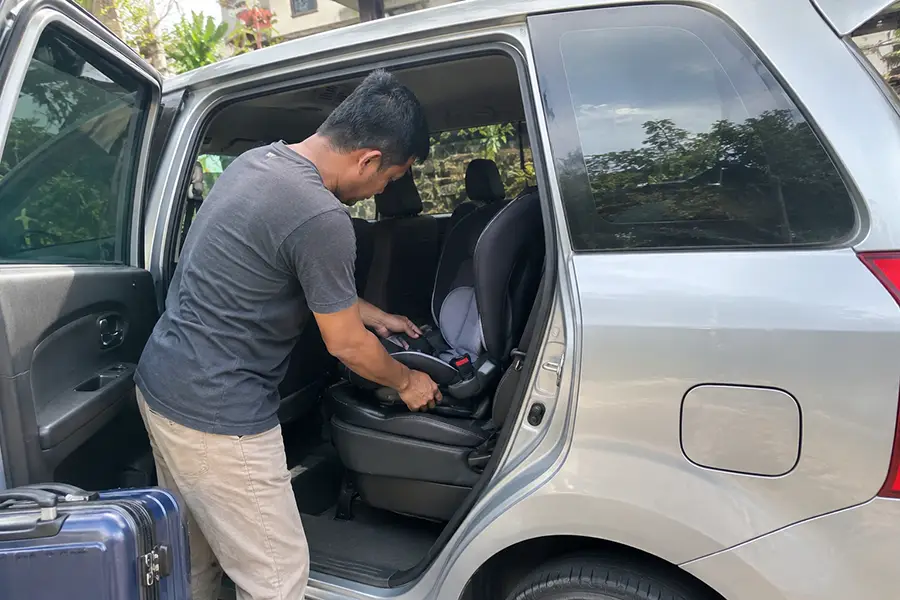
The first transport decision is usually the journey from Ngurah Rai International Airport to your accommodation.
After an international flight, families may have several bags, tired children, a stroller and hand luggage. That makes the pickup process more important than it may appear when you are planning the trip from home.
A pre-booked airport transfer can give you a predetermined pickup arrangement rather than leaving the decision until after you collect your luggage.
Give the driver useful arrival information
Your booking should match your actual flight details.
Provide:
- Flight number
- Arrival date
- Scheduled arrival time
- Number of passengers
- Destination
- Luggage requirements
- Child-seat requirements
If your accommodation is a villa, include the exact villa name and address if possible. Some Bali addresses can be difficult to identify from a name alone.
Know your meeting point
Do not assume that every airport transfer company uses the same meeting location.
Your confirmation should tell you where to meet the driver and how you will identify them. If the provider uses a name sign, check what name will appear on it.
For families, a clearly defined meeting arrangement can be particularly useful because it avoids having to make several decisions while managing children and luggage.
Child Seats: Request Them Before You Fly
A child seat should be treated as a specific booking requirement, not an assumption.
When requesting a seat, provide the child’s:
- Age
- Approximate weight, if requested
- Number of children requiring seats
- Type of seat you need, if known
Do not simply write “two kids” on a booking form and assume the provider will know what equipment you need.
Child-seat availability and the type of seat supplied can vary between providers and vehicles. Confirm the arrangement directly before travelling.
If you are travelling with an infant, also consider how much space the family needs around the seat. A vehicle that works for two adults and two children without much luggage may feel considerably tighter once you add a stroller, large suitcases and baby equipment.
For more family-specific considerations, see this guide to a family-friendly Bali airport transfer.
Bring your own seat if it is important to you
Some Australian families may prefer to travel with their own approved child restraint.
If you do this, check your airline’s baggage rules before departure and confirm whether your particular restraint is suitable for use in the vehicle you will be travelling in.
Do not assume that an Australian child-restraint arrangement will automatically translate to every vehicle in Bali.
Luggage: Choose the Vehicle Around What You Actually Carry
Passenger capacity is only one part of the vehicle decision.
A family of four travelling with four large suitcases, carry-on bags and a stroller has different requirements from four people travelling with backpacks.
Before booking, make a simple luggage count:
| What you are carrying | Why it matters |
| Large suitcases | Need usable boot or luggage space |
| Carry-on bags | Can take up passenger space |
| Stroller | May require dedicated luggage space |
| Baby equipment | Adds extra bulk |
| Surfboards or sports equipment | May require a larger vehicle |
| Multiple child seats | Can affect seating arrangements |
Avoid choosing a vehicle based only on the advertised number of seats.
Ask the provider whether your passenger count and luggage combination will fit comfortably in the requested vehicle.
If you are moving between several hotels, keep an updated list of each destination. This becomes especially important if your itinerary includes Ubud, Canggu, Seminyak, Sanur, Nusa Dua, Uluwatu or another area rather than staying in one location.
Plan Transport Beyond the Airport
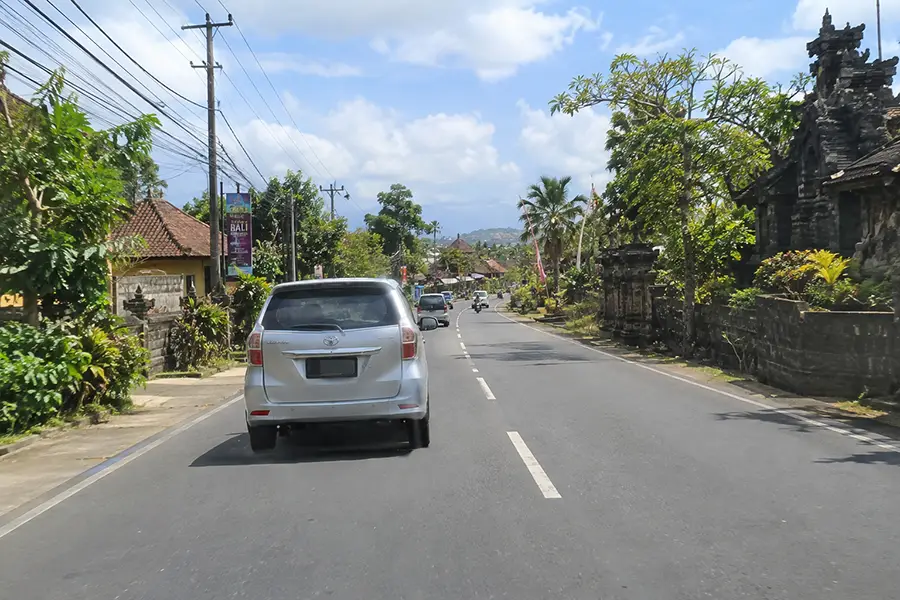
Your airport transfer is only one part of the trip.
Australian families often build Bali itineraries around several accommodation areas or day trips. That can mean multiple transport decisions during a single holiday.
Hotel-to-hotel transfers
If you are changing hotels, decide whether you need:
- A direct private transfer
- A hotel-arranged vehicle
- A driver for the day who can accommodate the transfer between stops
If you have young children or substantial luggage, avoid creating an unnecessarily complicated transfer chain.
A direct vehicle can also be useful when the next destination is outside the area where you started your trip.
Day trips with a driver
For sightseeing days, a private driver can be useful when the itinerary includes several stops.
Before booking, identify:
- Where you want to start
- Main destinations
- Approximate number of stops
- Whether children will travel with you all day
- Whether you need space for shopping or equipment
- Where you want to finish
Do not build a schedule around exact road travel times. Traffic can change the amount of time available at each attraction.
A better approach is to choose a few priority stops and keep less important stops flexible.
Airport-to-boat connections
If you are travelling onward to Nusa Penida or Nusa Lembongan, pay particular attention to the connection between your flight and boat departure.
Allow enough time for:
- Immigration and baggage collection
- Meeting your driver
- Road travel
- Traffic delays
- Check-in requirements at the harbour
A tight connection can turn a minor flight delay into a much larger problem.
Peak Traffic: Build Flexibility Into Your Day
Traffic is one of the biggest variables in Bali transport planning.
The same route can take different amounts of time depending on the day, hour, road conditions and destination. School-holiday travel can also increase demand for transport and attractions, but it should not be treated as a guarantee of a particular traffic level.
For this reason, avoid scheduling important fixed-time activities immediately after a long road journey.
For example, if you have a restaurant reservation, boat departure or flight later in the day, allow a buffer rather than calculating the itinerary using an ideal travel time.
Plan around the journey, not only the destination
A useful family itinerary might look like:
Morning: Leave accommodation
Late morning: Main attraction
Lunch: Nearby area
Afternoon: One or two flexible stops
Late afternoon: Return before a fixed evening commitment
This gives your driver and family some room to adjust if traffic is slower than expected.
Avoid overloading one day
A long list of attractions can look efficient on a map but become tiring when travelling with children.
Three or four meaningful stops may be more practical than trying to cross the island repeatedly.
Group destinations geographically where possible.
A Simple Bali Transport Checklist for Australian Families
Use this checklist before leaving Australia.
Before booking
- Confirm your state’s school holiday dates
- Check all flight dates and times
- List every passenger and child’s age
- Count large and small luggage items
- Include stroller or bulky equipment
- Decide whether you need child seats
- List hotel and villa addresses
- Identify any boat or domestic-flight connections
When booking
- Give the correct flight number
- Confirm the airport meeting point
- Confirm vehicle type
- Confirm luggage suitability
- Request child seats specifically
- Check the provider’s cancellation or amendment terms
- Save the booking confirmation
Before flying
- Recheck your flight details
- Confirm your accommodation address
- Confirm airport pickup instructions
- Save driver contact details
- Screenshot important booking information
- Reconfirm any child-seat arrangement
- Check the timing of onward travel
During the holiday
- Allow extra time for longer road journeys
- Keep fixed-time bookings realistic
- Avoid packing too many destinations into one day
- Tell your driver about changes to the itinerary
- Recheck departure-day pickup arrangements
How to Make Your Bali Transport Plan Work Better
The simplest approach is to divide transport into three categories:
Fixed: airport transfers, flights, boat departures and other time-sensitive connections.
Planned: full-day drivers, hotel changes and major sightseeing days.
Flexible: short local journeys, restaurants, shopping and spontaneous stops.
Book the fixed elements first. Plan the important longer journeys next. Leave the short trips flexible.
This approach is particularly useful for families because it reduces the number of decisions you have to make immediately after landing.
It also prevents the airport transfer from becoming the only transport arrangement you have considered. If your holiday includes multiple destinations, look at the entire route before choosing individual vehicles.
When Should Australian Families Book Bali Transport?
For June and July school-holiday travel, it is sensible to arrange important transport in advance rather than waiting until arrival.
There is no universal deadline that guarantees availability because providers, vehicles and travel dates differ. Families with specific requirements — especially child seats, larger vehicles or multiple luggage items — should allow additional planning time.
The key is to communicate the requirements clearly when you book.
If your itinerary is already confirmed, you can arrange your airport transfer first and then add the longer journeys once your accommodation and activities are finalised.
Final Takeaway
The most useful Bali school holiday transport guide Australia families can follow is straightforward: check your own school holiday dates, book important airport and inter-destination transport ahead of time, communicate child-seat and luggage requirements clearly, and leave extra flexibility for Bali road travel.
June and July can be a busy period for Australian families travelling overseas, but school holiday dates vary between states and actual Bali transport conditions vary by day. Treat peak-season information as planning guidance rather than a prediction.
Before departure, make sure your airport pickup, vehicle size, luggage requirements and child-seat arrangements are confirmed. Then build the rest of your Bali transport plan around the destinations you actually want to visit.
For families who already know their flights and accommodation, the next practical step is to review the available airport transfer options and provide your complete travel details when booking.

Frequently Asked Questions
Are June and July busy times for Australian families travelling to Bali?
They can overlap with winter school holidays in several Australian states, but the exact holiday dates vary. Check your state or territory’s official school calendar before planning your travel dates.
Should I book a Bali airport transfer before leaving Australia?
For families with a fixed arrival time, multiple bags, a child seat or a larger vehicle requirement, arranging the airport transfer before departure can make the arrival plan clearer. Confirm the provider’s meeting-point and booking terms in advance.
Can I request a child seat for a Bali airport transfer?
You can request one from your transport provider, but do not assume it is automatically included. Give the child’s age and any other relevant details and confirm the seat arrangement before travelling.
What size vehicle should a family book in Bali?
Choose the vehicle based on both passengers and luggage. A family with several suitcases, a stroller or child seats may need more practical space than the passenger count alone suggests.
Should I allow extra time for Bali road trips during school holidays?
Yes. Road conditions and traffic can vary, so avoid planning important flights, boat departures or reservations immediately after a long road journey. Keep some flexibility in sightseeing schedules.
Do I need to book every Bali journey in advance?
No. Prioritise fixed and important journeys such as airport transfers, hotel changes and boat connections. Short local trips can generally be decided closer to the time, depending on your itinerary and preferred transport method.
 for car rental in Bali, featuring comfortable cars and SUVs ready for island tours, airport transfers, and flexible travel across Bali.](https://www.balitouristic.com/wp-content/uploads/2025/02/Hotel-1-300x200.png)