
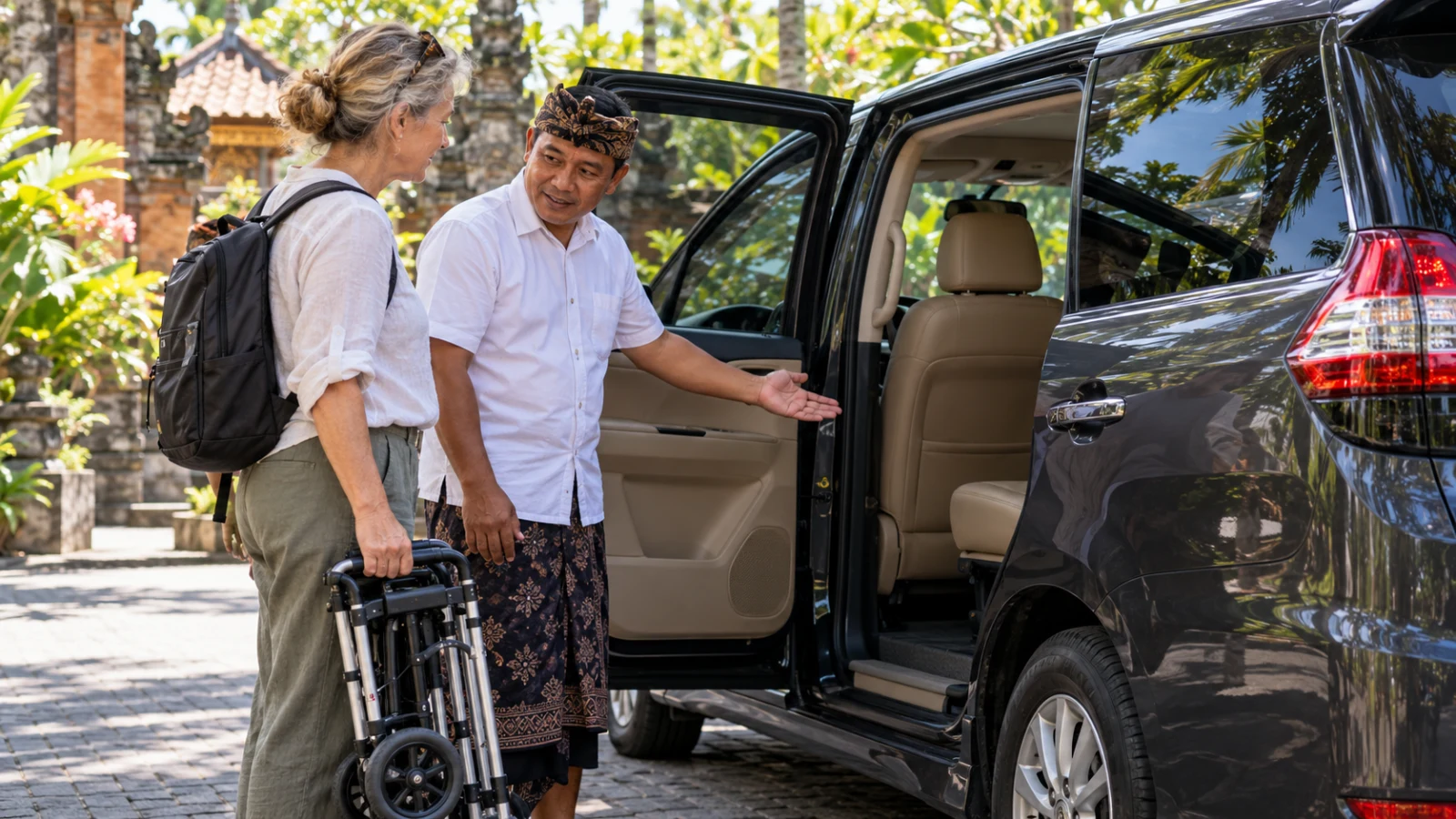
A Bali car with driver for limited mobility can make it easier to plan transport between your accommodation and the places you want to visit. However, a private car should not automatically be treated as an accessible vehicle. Before booking, confirm the exact vehicle, how easy it is to get in and out, whether there is room for your mobility equipment, and what access is like at each stop. The right choice depends on how the traveller moves, what equipment or assistance they use, and what they can comfortably manage on the day.
The most useful approach is to describe the traveller’s practical needs first, then ask the operator to confirm a specific vehicle and itinerary. A larger vehicle may offer more space inside, but that does not necessarily mean it has step-free entry or any special equipment. Treat each feature as unconfirmed until the operator has confirmed it for your booking.
If you are comparing transport options, start with the service details on the Bali car hire with driver page, then use the checklist below to decide whether the proposed arrangement suits your needs. That page describes the general service. It does not confirm any specialist accessibility equipment.

Needs assessment: describe the support required
“Limited mobility” can describe very different situations. One traveller may walk short distances but need frequent rests. Another may use a walking frame, transfer from a wheelchair into a car seat, or remain seated in a wheelchair for the whole journey. A person recovering from an injury may have different requirements from someone with a long-term mobility impairment. A useful enquiry explains the actual task the vehicle and driver may need to support.
List the practical details
- Walking ability: Can the traveller walk independently, manage a few steps, or only stand briefly with support?
- Transfer needs: Can they move from a wheelchair or mobility scooter to a standard passenger seat, and do they need another person to assist?
- Mobility equipment: Mobility equipment: What type is it (for example a folding wheelchair, walking frame or scooter)? Include its size and approximate weight.
- Seating and comfort: Is extra legroom, a particular seat height, a wide door opening, an easy-to-reach seat or room to change position important?
- Journey tolerance: How long can the traveller sit comfortably, and how often might they need a toilet stop, rest break or chance to stretch?
- Assistance boundaries: Explain what companions can provide and what requires trained or specialist assistance.
Do not rely on a diagnosis alone to communicate requirements. Two people with the same condition may have very different mobility, transfer and seating needs. Share only the information needed to plan transport, and ask the traveller what they are comfortable disclosing.
Vehicle questions: verify the actual car, not just its category

Labels such as MPV, SUV or minivan describe the general body style, not accessibility features. Ask the operator to name the exact vehicle proposed for your date and, where possible, to send recent photos or a short video of the door, seats and luggage area.
Questions to ask the operator
- Which exact vehicle will be provided on our date?
- How high is the step up into the vehicle, and are there handles to hold on to?
- How wide does the passenger door open, and is there room to transfer?
- Can the traveller use a standard seat, or do they need to stay in their wheelchair?
- If a wheelchair is carried, where will it be placed and how will it be secured?
- Can you send current photos of the actual vehicle and confirm it will be the one supplied?
If the traveller needs to stay seated in a wheelchair while the vehicle is moving, this is a different requirement from carrying a folded wheelchair. It generally calls for a vehicle designed or adapted for that purpose, with proper securing arrangements. Do not assume a standard car or van is suitable. If the operator cannot clearly confirm the arrangement, do not treat the vehicle as suitable for that need.
A private driver can help with ordinary travel arrangements, but this does not mean the driver is trained or able to help with lifting, transfers or personal care. Ask what help, if any, is offered, and arrange specialist support separately if you need it.
Local note: Many villas and guesthouses in Bali are down narrow lanes, and the entrance may have steps, a raised threshold or a sloping driveway. A car may not be able to stop right at the door, so ask the operator where the vehicle can actually wait and how far the traveller would need to go from there.
Mobility equipment: measure before requesting a vehicle
Your equipment can affect the choice of vehicle as much as the number of passengers. A folded wheelchair or walking frame may fit where a larger chair or scooter would not. Measure the equipment in the form in which it will travel and include the details in your enquiry.
What to prepare
- Size (length, width, height) and weight, if known.
- For powered equipment: the overall size, the battery type, and whether any parts can be removed. Ask the operator whether and how it can be carried safely.
- Whether the equipment must stay upright or needs careful handling.
- The number of suitcases and bags. The advertised passenger capacity may not leave room for mobility equipment once luggage is added.
- Who will load and unload the equipment, and where it will be placed.
If you are planning a day trip with a wheelchair, clarify whether the chair is only needed at destinations or must be used throughout the journey. Carrying a folded chair in the luggage area is not the same as travelling seated in it.
Destination access: check every stop separately
A vehicle that works for the journey does not make an attraction accessible. Bali destinations can include uneven paving, kerbs, steps, slopes, narrow entrances, gravel, sand, temple compounds and long distances between parking and the main area. Access can also change with weather, maintenance, ceremonies, crowds or temporary closures. Check the route from the vehicle drop-off point to the specific place the traveller wants to visit, not only whether the destination is described as accessible.
Build an access check for each destination
- Arrival and drop-off: Is there a practical place to stop close to the entrance, and is the route from the vehicle level, paved or otherwise manageable?
- Surface and gradient: Are there steps, steep ramps, loose gravel, sand, uneven stone or slippery sections?
- Distance: How far is it from the drop-off point to the main viewing area, toilet, restaurant or activity?
- Facilities: Is an accessible toilet available, and can its location and current condition be confirmed?
- Seating and shade: Are there places to sit and rest, and is shade available along the route?
- Alternative experience: If the main area cannot be reached, is there a nearby viewpoint or shorter visit that the traveller would still enjoy?
Contact the attraction directly when access information is unclear. Be cautious about general labels such as “wheelchair friendly” without details about the route and facilities.
A step-free itinerary in Bali may be possible for some stops, but plan it as a series of confirmed access points rather than assuming it across a whole area. Keep the schedule flexible and avoid fitting too many places into one day.
Companion planning: agree roles and realistic support
Before the trip, agree who will handle transfers, equipment, bags, communication with the driver and any other support. Do not leave these roles vague or assume the driver will take them on. Consider your companion’s own comfort and physical capacity as well. If specialist assistance is needed, arrange it through an appropriate provider rather than relying on a standard transport booking. Share a realistic itinerary with the operator, including the number of stops and the time needed at each one, and build rest breaks into the plan.
Confirmation checklist: get the important details in writing
Before paying or treating the arrangement as confirmed, send the operator a concise written summary of the traveller’s requirements. Ask them to reply against each point rather than giving a general assurance that a suitable car will be provided. Keep the response with your booking details so everyone is working from the same information.
- Passenger and companion count, plus the traveller’s practical mobility needs.
- Exact vehicle model, entry and seating details, and current photos where needed.
- Whether mobility equipment fits, how it is stored and who is responsible for handling it.
- Whether the traveller transfers to a passenger seat or remains in a wheelchair during travel; if the latter, the specific accessible vehicle and restraint arrangements.
- Pickup point, itinerary, stop durations, rest breaks and any agreed changes to the route.
- Destination access details checked directly with each attraction, including toilets and drop-off points.
- Total price, what is included, any overtime or area surcharges, and the deposit, cancellation and rescheduling terms.
- A contact method for communicating changes on the travel day.
If any essential point remains unanswered, pause before confirming. Ask for clarification or consider a different operator, vehicle or itinerary. A clear written response is more useful than a broad promise of comfort or accessibility.
For the general booking steps and how to check what a quote includes, see how to arrange a private driver in Bali. Send your enquiry as early as you can, as confirming vehicle and access details may take time.
Choose the arrangement only after the access details are clear
The best Bali car with driver for limited mobility is not necessarily the largest or most expensive vehicle. It is the arrangement that has been checked against the traveller’s transfer needs, equipment, seating requirements and planned destinations.
If you are considering Bali Touristic, send the team a WhatsApp message with your travel date, passenger and luggage details, equipment measurements and proposed itinerary, and ask which points can be confirmed for your requirements. Availability and suitability are confirmed individually for each booking, and no special accessibility feature should be assumed from a vehicle name or a standard service description.

FAQs
Can I ask for an accessible vehicle for a Bali car hire driver?
You can enquire about a vehicle that suits your mobility needs, but do not assume a standard private car is wheelchair-accessible. Ask for the exact vehicle, how you enter it, the seating and any equipment in writing before booking.
Can a wheelchair user travel in a regular car with a driver?
It depends on whether the traveller can transfer safely to a standard passenger seat and whether the folded wheelchair can be carried securely. A passenger who needs to remain in their wheelchair while travelling requires a specifically suitable vehicle and restraint arrangement.
Will the driver help with a wheelchair or mobility equipment?
Ask the operator what practical assistance the driver can provide. Do not assume the driver is trained or able to lift a passenger, assist with transfers or provide personal care. Arrange specialist support separately if required.
Are Bali attractions wheelchair-accessible?
Access varies by attraction and can include steps, uneven surfaces, slopes and long distances. Check the specific entrance, route, facilities and drop-off point directly with each destination before adding it to the itinerary.
What information should I send before booking?
Share the traveller’s walking and transfer abilities, equipment type and measurements, seating requirements, passenger and luggage count, proposed destinations and any assistance needed. Ask the operator to confirm the actual vehicle and arrangements in writing.