
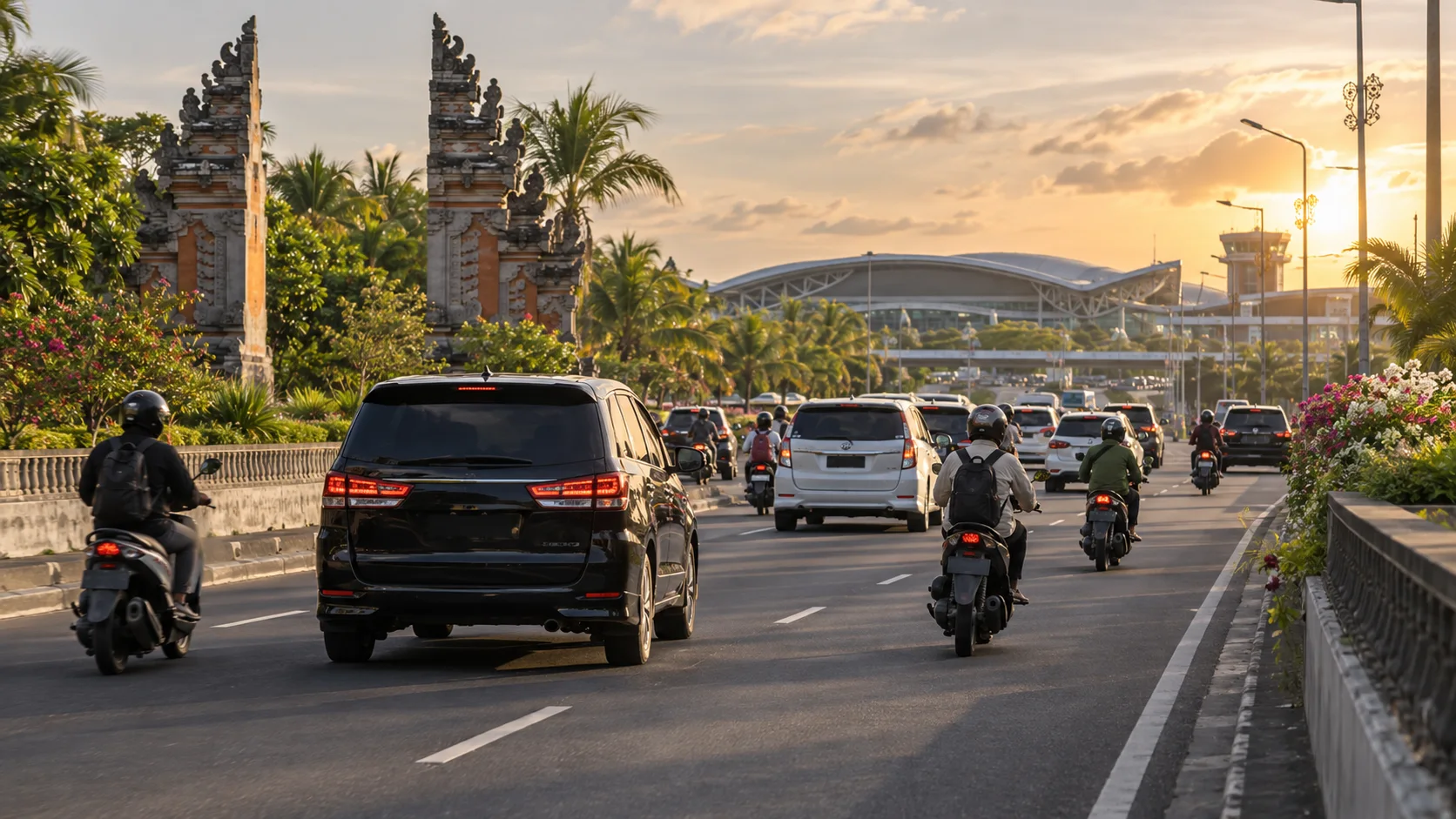
If you are planning a transfer from I Gusti Ngurah Rai International Airport (DPS), the time you leave the airport can make a noticeable difference to your journey. Bali airport traffic by time of day is influenced by more than the clock: weekday movement, resort-area congestion, rain, public holidays, ceremonies, events, and your destination all affect how long the road journey may take.
There is no single “best” departure time from Bali Airport that works for every traveller. A short journey towards Kuta can behave very differently from a longer trip towards Canggu, Ubud, Nusa Dua, or Uluwatu.
The practical approach is to think in traffic periods and buffers, rather than relying on one fixed travel-time estimate.
Ngurah Rai Airport itself provides designated arrival corridors and pick-up zones for passengers and vehicles, while international arrivals also pass through immigration, baggage collection and customs before reaching the meeting area.
If you already know your arrival time and destination, arranging a Bali airport transfer in advance can make the ground-transport part of your arrival easier to plan.

Why Bali Airport Travel Times Vary

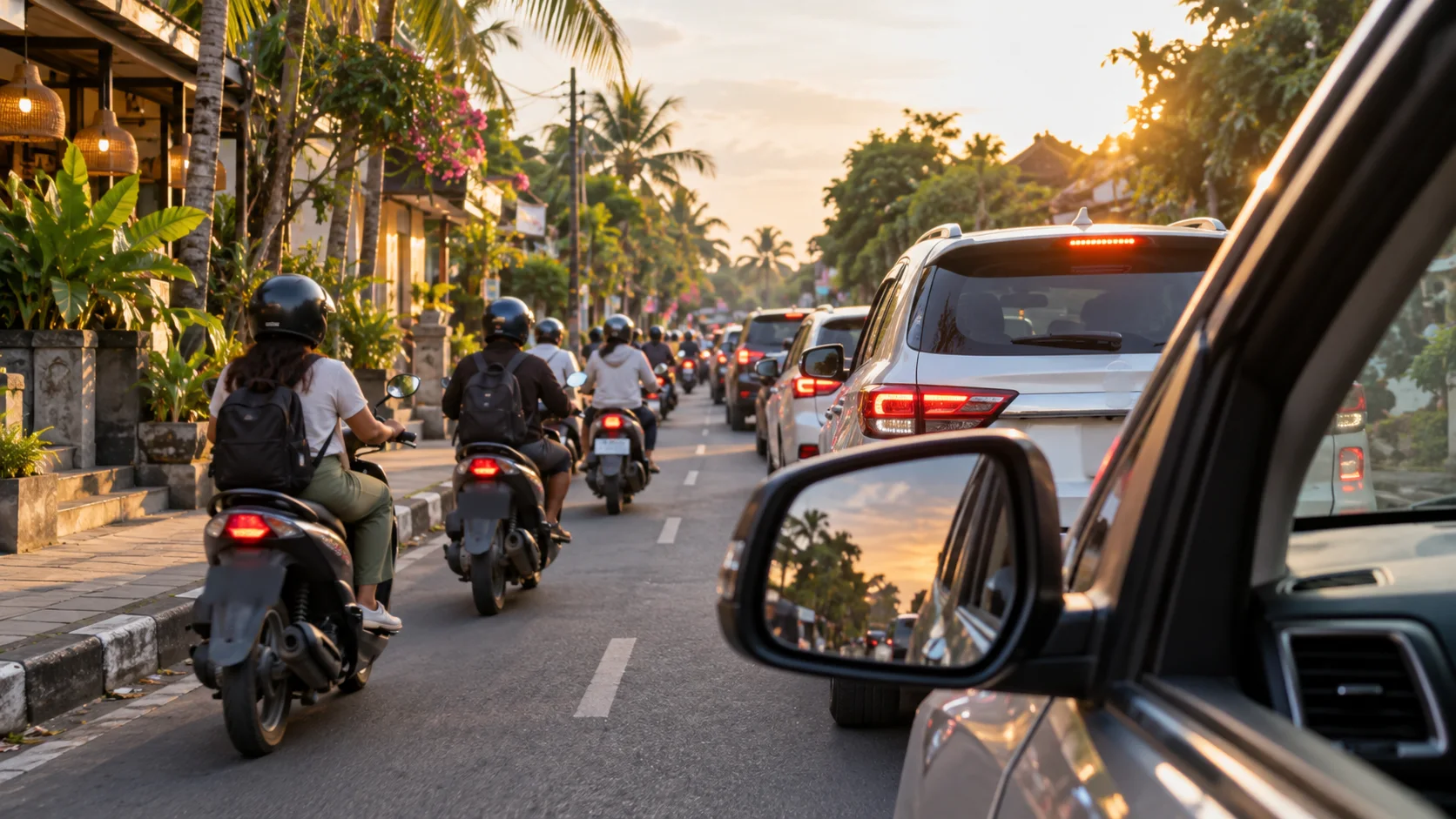
Bali’s traffic does not follow a simple airport-to-city pattern. Congestion can build on the roads between the airport and major tourist areas, and the effect depends heavily on the direction of travel.
Indonesia Travel notes that heavily populated parts of Bali can become congested during peak periods and that ceremonial processions can occupy roads.
Your actual transfer time can therefore be affected by several factors:
- Arrival time: Road conditions can change considerably between morning, midday, afternoon and evening.
- Destination: Kuta, Seminyak, Canggu, Sanur, Nusa Dua, Jimbaran, Uluwatu and Ubud use different road corridors.
- Day of the week: Weekday commuter movement can interact with tourist traffic.
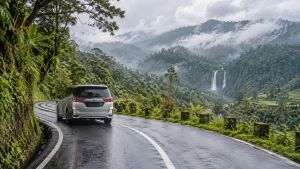
- Weather: Heavy rain can slow vehicles and create more difficult road conditions.
- Events and ceremonies: Festivals, temple ceremonies and other gatherings can temporarily alter traffic patterns.
- Flight timing: A delayed flight can move your actual airport exit into a different traffic period.
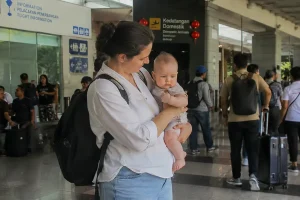
- Arrival processing: International passengers may need to allow time for immigration, baggage collection and customs before meeting their driver.
This is why a route advertised as a short drive under light traffic should not automatically be treated as the expected door-to-door journey time.
Bali Airport Traffic by Time of Day
Instead of treating one particular hour as universally good or bad, use the following periods as a planning framework.
Early morning: generally easier road conditions, but check the route
An early arrival can sometimes provide a simpler road journey, particularly before weekday activity builds around southern Bali.
However, “early morning” does not mean every route will be clear. The airport area, accommodation zones and individual roads can behave differently, and traffic conditions can change quickly.
For travellers landing early, the main question is not simply “Is Bali traffic quiet now?” It is:
What route will I take from the airport, and what traffic is likely to develop before I reach my destination?
This matters more for destinations farther from the airport. A journey that begins under light traffic may encounter heavier conditions later along the route.
Morning: allow for increasing local movement
As the morning progresses, road activity generally becomes more relevant to transfer planning.
For weekday arrivals, allow additional flexibility if your destination requires travelling through busy urban or commercial areas. The airport is located in Tuban, between Kuta and Jimbaran, and connects directly with the wider southern Bali road network.
Morning conditions can therefore be quite different depending on whether you are travelling:
- towards nearby Kuta or Jimbaran;
- east towards Sanur and beyond;
- north towards Ubud;
- west towards Seminyak and Canggu; or
- south towards Nusa Dua and Uluwatu.
Rather than choosing a transfer based only on the shortest nominal driving distance, consider the time window in which your vehicle will actually be on the road.
Midday: often easier to plan, but not automatically clear
Midday can be a useful planning window because it sits outside some of the strongest commuter periods. However, this should be treated as a general planning consideration rather than a guarantee of light traffic.
Tourist movement remains active throughout the day, and popular areas can experience congestion independently of airport traffic.
For example, Indonesia Travel describes Seminyak as an area where traffic can become very congested at times.
This means a traveller arriving at the airport around the middle of the day may still experience a slower journey once the vehicle reaches a busy resort area.
If your arrival is around midday, check the destination rather than assuming the entire route will be equally clear.
Afternoon: build more flexibility into the journey
Afternoon transfers deserve particular attention when the destination is in a busy resort corridor.
Traffic can change as local activity, tourism and later-day movement overlap. A journey that starts near the airport may become slower closer to Seminyak, Canggu, Uluwatu or another popular area.
This is particularly important if you have a second commitment after arriving in Bali, such as:
- a restaurant reservation;
- a tour departure;
- a boat connection;
- a spa appointment;
- an attraction with a timed entry; or
- a domestic flight from another location.
For these plans, do not schedule the next activity immediately after your estimated airport arrival time. Leave room for both airport processing and road conditions.
Evening: destination matters as much as airport proximity
Evening traffic should not be treated as one uniform period.
A traveller heading to a nearby airport-area hotel may have a very different experience from someone travelling north or west through busy tourist districts.
For example, road conditions around Uluwatu can become heavier during periods of tourist movement, while Seminyak has its own congestion patterns. Indonesia Travel specifically notes that traffic in Seminyak can become very congested at times.
For an evening arrival, the useful question is therefore:
Where will the vehicle be travelling when traffic is busiest?
This is more useful than simply asking what time your flight lands.
Weekends, Holidays and Events Can Change the Pattern
A weekday traffic pattern should not be copied directly onto a weekend or holiday itinerary.
Bali receives substantial tourist movement, and major holidays, ceremonies and events can create unusual road conditions. Indonesia Travel warns that ceremonial processions can occupy roads, while airport authorities have documented temporary traffic diversions around the airport during major ceremonial periods.
Nyepi is an especially important example. Ngurah Rai Airport suspended normal flight operations for 24 hours during Nyepi in 2025, with the airport publishing the operational change and related aviation notice in advance.
For other events, the effect may be local rather than island-wide.
Before travelling, check:
- your exact arrival date;
- public holidays;
- major festivals or sporting events;
- temple ceremonies affecting your route;
- planned road restrictions;
- hotel or destination-area events; and
- current airport and airline information.
The closer your itinerary is to a major event, the less useful a normal “Bali airport traffic” estimate becomes.
Rain Can Add Another Layer of Uncertainty
Weather is one of the reasons it is risky to treat travel-time estimates as fixed.
Rain can reduce road speeds and make already-busy roads slower to navigate. During periods of heavier rainfall, allow additional flexibility rather than assuming the same conditions as a dry-weather journey.
Indonesia’s official tourism information has also highlighted periods of high rainfall and the potential effects of severe weather on transport planning.
For travellers arriving during wetter periods, a practical approach is to:
- Check the weather forecast before leaving the airport.
- Allow extra road time if heavy rain is expected.
- Avoid scheduling an important activity immediately after your estimated arrival.
- Keep your hotel and driver contact details available.
- Check current traffic conditions shortly before departure.
Rain does not automatically mean severe delays, but it is one more variable that makes an exact journey-time promise unreliable.
Route Examples: Why Destination Changes the Calculation
The airport is close to several major tourist areas, but the road journey can become more complicated as you move farther from the airport.
| Destination area | What to consider when planning |
| Kuta | Close to the airport, but local congestion can still affect the final part of the journey. |
| Jimbaran | Relatively close to DPS, but route conditions depend on the exact accommodation and road conditions. |
| Nusa Dua | The direction and road conditions can differ from westbound routes towards Seminyak and Canggu. |
| Sanur | Eastbound travel uses a different corridor from many west-coast resort routes. |
| Seminyak | Traffic can become heavily congested at times, so airport distance alone is not a reliable planning measure. |
| Canggu | The longer west/north-west route means traffic conditions later in the journey can be just as important as those around the airport. |
| Ubud | The transfer continues inland, so a clear airport exit does not necessarily mean the entire journey will remain clear. |
| Uluwatu | Later-day tourist movement can affect travel towards the southern peninsula. |
For a Canggu-specific planning question, see the Bali Airport to Canggu travel time guide for route-level context.
The important distinction is that this article explains island-level traffic timing, while individual route pages should provide the more specific destination information.
Plan Your Transfer Around Your Actual Arrival Time
The best time to leave Bali Airport is not necessarily the time your aircraft touches down.
For an international arrival, you still need to pass through the arrival process before reaching the meeting and pick-up area. The airport’s current international arrival guidance lists immigration, baggage collection and customs before the arrival corridor and pick-up zone.
This creates two separate timing questions:
- When does the aircraft arrive?
This is the flight’s scheduled or actual landing time.
- When will you be ready to leave the airport?
This depends on immigration, baggage, customs, walking time, meeting arrangements and any flight delay.
For domestic arrivals, the airport’s arrival guide directs passengers towards baggage collection and then the arrival corridor and pick-up zone.
A useful transfer plan therefore starts with your expected airport exit window, rather than treating landing time as the beginning of the road journey.
Bali Airport Traffic Planning Checklist
Before booking or confirming your transfer, check the following:
Before your flight
- Confirm your flight number and scheduled arrival time.
- Identify whether you are arriving domestically or internationally.
- Confirm your destination and full accommodation address.
- Check whether your arrival falls on a public holiday or major event.
- Look at the weather forecast for your arrival period.
- Consider whether you have a fixed appointment after arrival.
On arrival day
- Check whether your flight is delayed.
- Reassess the traffic conditions before leaving the airport.
- Allow enough time for immigration, baggage and customs if arriving internationally.
- Confirm where you will meet your driver.
- Keep your accommodation details and driver contact information accessible.
Ngurah Rai Airport identifies its arrival corridor as an area for meeting and pick-up, with designated pick-up zones for vehicles collecting passengers and luggage.
If you have a time-sensitive plan
Give yourself a larger buffer when:
- travelling during a busy traffic period;
- travelling to a destination far from the airport;
- arriving during heavy rain;
- travelling during a public holiday;
- attending an event;
- connecting to another timed activity; or
- travelling with children, large luggage or a group.
The goal is not to predict traffic perfectly. It is to make your itinerary resilient if the road takes longer than expected.
How Much Buffer Should You Allow?
There is no universal buffer that can be applied to every Bali airport journey.
Instead, scale your buffer according to the number of variables involved.
A short transfer to a nearby area on a relatively quiet day requires a different approach from a long transfer during a busy period or heavy rain.
A useful rule is:
More distance + busier period + weather uncertainty + fixed appointment = more buffer required.
Do not build an itinerary around the fastest possible journey. Plan around a realistic range and leave room for changes.
This is particularly important for travellers who have another booking immediately after the airport transfer. A small road delay can become a much larger problem when there is no flexibility between activities.
Should You Book a Private Transfer Around a Specific Time?
If your main concern is knowing how the airport journey fits into your itinerary, a pre-arranged private transfer can make the logistics clearer.
The key is to provide accurate flight and destination information and to understand that traffic conditions remain outside the control of any road-transfer provider.
The airport publishes current flight information and operational guidance, so check those sources alongside your transfer arrangements rather than relying on a fixed journey-time assumption.
For the most practical planning, think in this order:
flight arrival → airport processing → meeting point → traffic period → destination route → next activity.
That sequence gives you a more realistic picture than simply calculating the distance between DPS and your hotel.

Final Takeaway: Plan for a Range, Not a Single Time
Understanding Bali airport traffic by time of day is mainly about recognising patterns without treating them as guarantees.
Morning, midday, afternoon and evening can produce different road conditions, but the destination, day of the week, weather and local events can change the picture. Bali’s official tourism information confirms that roads in heavily populated areas can become congested during peak periods and that ceremonies can affect road access.
For your own transfer, start with your actual flight arrival, work out when you are likely to exit the airport, identify the traffic period you will travel through, and then add a sensible buffer for the route.
If your itinerary includes a timed activity after landing, plan conservatively and confirm current conditions on the day. If you simply need to reach your hotel, use the traffic period as guidance rather than trying to find one “perfect” departure time.
That approach makes Bali transfer travel time easier to plan without pretending that DPS traffic follows a fixed daily schedule.
Frequently Asked Questions
What is the best time to leave Bali Airport?
There is no single best time for every route. Earlier or midday departures may sometimes avoid certain busy periods, but conditions depend on the destination, weekday, weather and events. Check the route and current conditions on your travel day.
Is Bali Airport traffic worse in the morning or evening?
It can vary by route. Morning traffic can overlap with local weekday movement, while later-day traffic can coincide with tourist activity in popular resort areas. The destination is as important as the time of departure.
How much extra time should I allow for Bali airport traffic?
There is no fixed amount that applies to every journey. Allow more flexibility for longer routes, busy periods, rain, holidays, ceremonies and any trip followed by a time-sensitive activity.
Does rain affect travel time from Bali Airport?
It can. Heavy rain may reduce road speeds and make existing congestion more difficult. During periods of poor weather, check current conditions and allow additional flexibility.
Does the day of the week affect Bali airport traffic?
Yes, the traffic pattern can differ between weekdays, weekends and holiday periods. Local events and ceremonies can also create temporary congestion or diversions, so a normal weekday estimate should not automatically be applied to every date.
Should I use my flight landing time as my transfer departure time?
No. Your actual departure from the airport comes after the relevant arrival procedures. International passengers, for example, need to complete immigration, collect baggage and clear customs before reaching the arrival corridor and pick-up area.