
Planning a Bali car with driver for groups of 13 to 19 requires more than finding a minibus with enough seats. You need to match the passenger count to the vehicle’s approved seating configuration, allow space for luggage, consider whether a separate luggage vehicle is needed and check that every stop is accessible to a larger vehicle. For some groups, one suitable minibus may work; for others, two vehicles will be more practical.
The right arrangement depends on the exact number of travellers, the amount and size of their bags, the route and how often the group needs to board and leave the vehicle. Confirm these details with the operator before paying a deposit or finalising the itinerary.
If you are comparing transport arrangements, start by sharing your passenger and luggage count, travel dates and planned stops with the provider. You can review the available private driver and vehicle service once you know what type of setup your group needs.

Vehicle options for a group of 13 to 19
A group in this size range is generally beyond the practical capacity of an ordinary family MPV. The main decision is whether a larger minibus can carry everyone and their belongings within the vehicle’s seating capacity, or whether the group should travel in more than one vehicle.
One minibus for the whole group
A minibus may keep the group together and simplify coordination at each stop. An Isuzu Elf minibus is one option travellers may ask about, alongside other locally available minibus models. However, the name or model alone does not confirm how many people a particular vehicle can safely or comfortably carry. Seating layouts, vehicle versions and luggage arrangements can differ.
Do not assume that a vehicle described informally as a 15-seater can take 15 passengers plus a driver and a full set of suitcases. Ask the operator to confirm the exact passenger seating capacity, whether that figure includes the driver, and how much luggage can be carried at the same time.
Two vehicles or a minibus with a luggage vehicle
For 16 to 19 travellers, or for a smaller group with bulky luggage, two passenger vehicles may be the more workable choice. Another arrangement is a passenger minibus accompanied by a separate luggage vehicle. This can preserve passenger seating and avoid stacking bags in aisles or blocking exits.
The trade-off is coordination. Two vehicles need agreed meeting points, clear communication between drivers and a plan for parking together where possible. A luggage vehicle also needs to travel with the group and be included in the pickup, stop and return arrangements.
A larger vehicle is not automatically better for every itinerary. If your group includes several families, children or travellers who need more personal space, compare the layout and boarding arrangements as carefully as the seat count. For smaller family parties travelling separately, the guide to family car rental options in Bali may help with the vehicle choices for those individual bookings.
When comparing quotes, look beyond the vehicle name and ask for a clear description or photograph of the actual seating layout where possible. Check whether seats are forward-facing, whether there is room for passengers to enter and leave without moving other people, and whether any seat is being counted despite being unsuitable for your party. The operator should make the final capacity assessment for the specific vehicle and journey. If your group includes children, ask how their seating will be arranged and whether any child seats are required and available; do not assume these can be fitted to every minibus.
Passenger capacity and luggage need separate checks
The most common planning mistake is treating the maximum passenger figure as proof that the vehicle can also carry everyone’s luggage. A group of 15 with small daypacks has different space requirements from 15 people arriving with large suitcases, sports equipment, prams or musical instruments.
Prepare a luggage count before requesting a quote. Include the number of large suitcases, cabin bags, backpacks and any unusually shaped items. If bags will remain in the vehicle during sightseeing, say so. If the group needs to transport luggage between accommodation locations, make that clear as well.
Ask the operator to confirm the proposed vehicle arrangement in writing. A useful confirmation should identify the passenger vehicle or vehicles, the number of seats available for your group, the luggage plan and whether any bags will travel separately. If the operator cannot confirm that everything fits without obstructing passenger space or access, revise the setup rather than relying on a last-minute adjustment.
| Planning detail | What to provide | What to confirm |
| Passengers | Exact adult and child count | Approved seats available for passengers |
| Large luggage | Number and approximate size | Whether bags fit in the passenger vehicle |
| Cabin bags and daypacks | Quantity and where they will be kept | Whether storage affects legroom or access |
| Special items | Prams, wheelchairs, sports or event equipment | Separate vehicle or specific loading arrangement |
| Multi-vehicle plan | Who rides in each vehicle | Meeting points and driver communication |
Allow extra time for group boarding
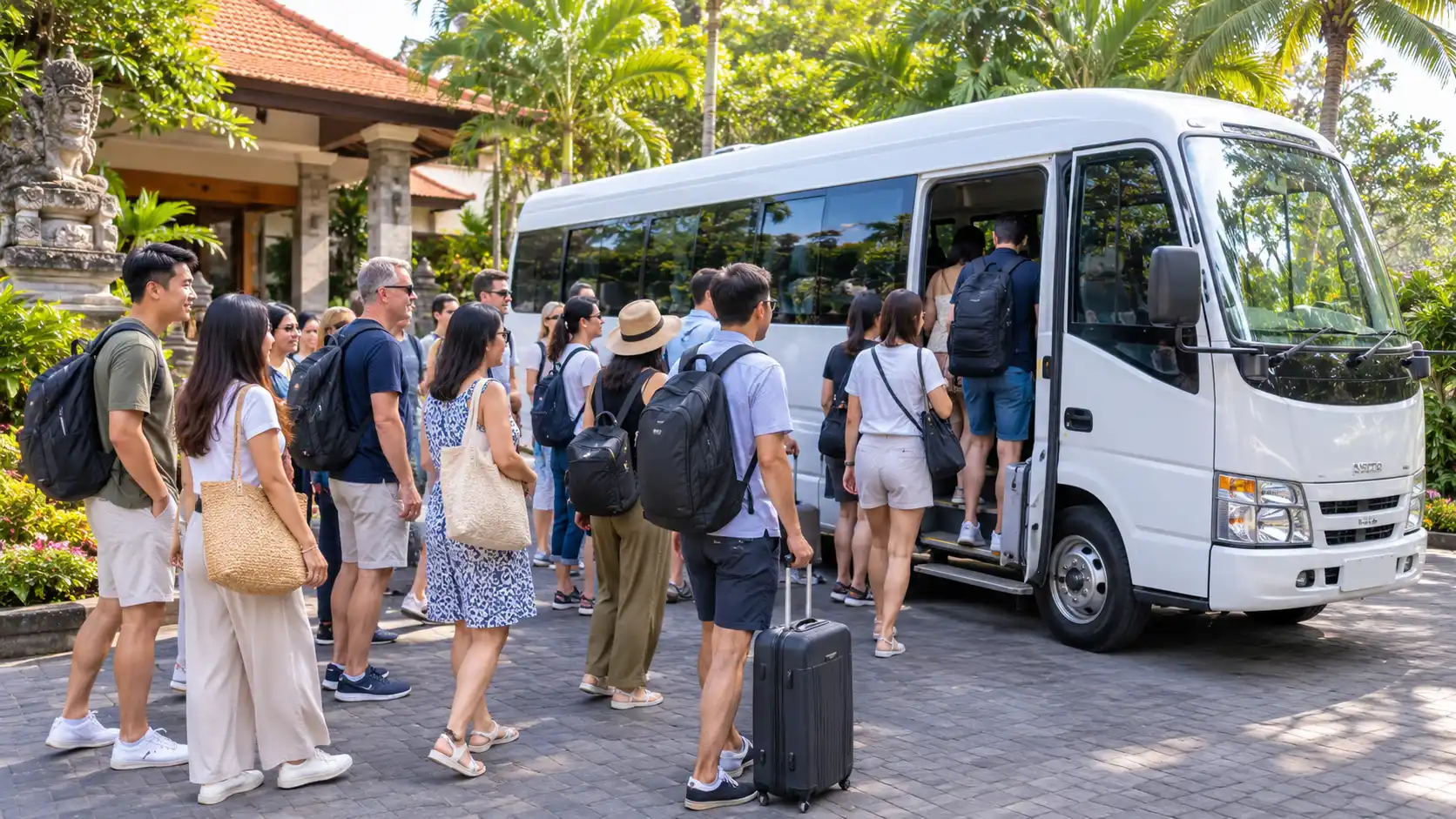
A group of 13 to 19 rarely boards as quickly as a couple or a small family. People may need to find their assigned seats, stow bags, help children or older relatives, check that nobody has been left behind and coordinate with a second vehicle. Build this time into the pickup and every major departure.
Before the day, nominate one organiser to communicate with the driver or drivers. Ask the group to be ready at the agreed meeting point before the scheduled departure time, rather than arriving individually at the last minute. A simple passenger list or seating allocation can help, particularly when two vehicles are involved.
At attractions and restaurants, agree on a clear return point and a departure time. If the vehicle cannot park directly beside the entrance, tell the group where to meet and allow time to walk there. Keep the aisle and door areas clear; bags should not be left where they could obstruct boarding or movement inside the vehicle.
Check road access and stopping arrangements
Bali’s roads vary considerably. Busy town streets, narrow village lanes, steep approaches, tight bends and limited parking can make some locations difficult for a large minibus. A route that is straightforward for a small car may not be suitable for a longer or taller vehicle.
Send the operator the actual destinations and, where possible, the names of the accommodation, restaurants and attractions. Ask whether the proposed vehicle can reach the pickup point and each stop, or whether the group will need to walk from a larger road or use a smaller transfer vehicle for part of the route. Do not assume that a map route proves a minibus can safely reach the final entrance.
For venues with limited parking, confirm where the vehicle can wait and how the group will reunite after the visit. If the itinerary includes rural locations, temples, beaches or viewpoints, check access with the operator before fixing the schedule. The driver may recommend a practical drop-off point, but any alternative should be agreed with the organiser and communicated to the group.
The route also affects vehicle choice. A minibus may be suitable for the main roads between areas but still need a different drop-off point near a particular venue. Ask about road width, turning space, low clearance, steep access and the availability of a safe place to stop. These checks are especially useful when the accommodation is on a narrow lane or when the itinerary includes several small venues. If a smaller shuttle or a short walk is proposed, make sure the group understands the arrangement before departure.
Build a realistic schedule for a large group
A group itinerary needs more flexibility than a private trip for two. Every stop involves collecting people, checking belongings and making sure both vehicles are ready to leave. A schedule with many short visits can quickly become rushed, especially when traffic, weather or parking conditions change.
Prioritise the places that matter most and group them by area where possible. Leave a buffer around meal stops and activities with fixed start times. Avoid planning a long cross-island route with several brief stops unless the group is comfortable spending much of the day travelling.
Travel times should be treated as estimates, not guarantees. Traffic, weather, roadworks, ceremonies, pickup location and the number of stops can all affect the day. Ask the operator to review the route and suggest a realistic order. If the group uses two vehicles, agree that both will follow the same itinerary and identify what happens if one is delayed.
Clarify the booking duration, start and finish points, waiting arrangements, possible overtime and any route-related extra charges before confirming. Do not assume these details are identical across operators or vehicle types.
For a multi-day visit, review the transport plan for each day rather than assuming one vehicle will suit every route. A day spent around central tourist areas may involve different access and parking conditions from a day travelling through rural or hilly areas. Confirm whether the same vehicle arrangement is intended throughout the booking, and tell the operator if the passenger count or luggage load changes between days.
Organiser checklist before booking
Send one complete request rather than asking for a vehicle based only on the group size. Include:
- Travel date, pickup time, pickup address and final drop-off location.
- Exact passenger count, including children, and any seating requirements.
- A luggage inventory covering large suitcases, cabin bags and special equipment.
- Every planned stop, including venues with narrow access or limited parking.
- Whether the group needs one vehicle, multiple passenger vehicles or a luggage vehicle.
- Expected time at each stop and any fixed activity or restaurant booking.
- A contact person who can coordinate the group and communicate with the driver.
- The confirmed vehicle configuration, total price, inclusions, exclusions, booking duration and overtime policy.
Ask for the final arrangement in writing. The confirmation should make clear how many vehicles are being supplied, how many passengers each will carry, where luggage will go and how the group will coordinate during the day. If any part is still uncertain, resolve it before travel day.
Match the vehicle plan to your group before you book
Choosing a Bali car with driver for groups of 13 to 19 is mainly a matter of matching the passenger count, luggage and route to a workable vehicle plan. A single minibus may suit some groups, while others will need two passenger vehicles or a separate luggage vehicle. Confirm the actual seating configuration, storage space, boarding buffer and road access before you settle the itinerary.
For a tailored recommendation, send Bali Touristic your travel date, exact passenger and luggage count, pickup point and planned stops. Ask the team to confirm the proposed vehicles and all booking conditions in writing before you proceed.

FAQs
Can one minibus carry 19 people in Bali?
It depends on the specific vehicle, its approved passenger seating and the luggage load. Do not assume that a minibus can carry 19 passengers simply because it is described as a group vehicle. Ask the operator to confirm the exact configuration for your date.
Is an Isuzu Elf suitable for a group of 15?
It may be an option, but Isuzu Elf configurations differ. Confirm the passenger seats available after allowing for luggage, and request another vehicle if the group and bags cannot be accommodated appropriately.
Should a group of 16 to 19 book two vehicles?
Often, two vehicles are worth comparing, particularly when the group has substantial luggage or needs more flexible access. The best arrangement depends on the confirmed vehicle capacity, route and budget.
Do we need a separate luggage vehicle?
Not always. It may be useful when suitcases or equipment would take up passenger seating or reduce usable cabin space. Share a complete luggage count so the operator can recommend a suitable arrangement.
How much extra boarding time should we allow?
There is no single time that suits every group. Allow more time than you would for a small party, especially when there are multiple vehicles, children, older travellers or many bags. Agree a realistic pickup buffer with the operator.
Can a minibus reach every attraction in Bali?
No. Some roads, entrances and parking areas may not suit larger vehicles. Give the operator the full itinerary and confirm drop-off points and any walking or smaller-vehicle transfers in advance.