


Your first day in Bali should be planned around your actual landing time, not simply the number of attractions you want to see. After the flight, you still need to allow time for immigration, baggage collection, customs, the journey from Ngurah Rai International Airport, hotel check-in and possible traffic delays.
For most travellers, the best approach is to choose one of four arrival-day plans: morning, midday, afternoon or evening. A morning arrival can leave enough time for a light sightseeing stop before check-in. A midday arrival usually works better with lunch and a direct transfer to your accommodation. An afternoon arrival may suit a nearby sunset or dinner, while a late evening arrival is usually better kept simple.
Ngurah Rai Airport’s official arrival guidance directs international passengers through immigration, baggage collection and customs before they exit towards the arrival corridor and pickup zone. Domestic arrivals still need to collect baggage before leaving the terminal.
The key is to treat airport arrival as the start of your Bali day, not as the first sightseeing activity itself.

Arrival-Time Decision Tree

Use your scheduled landing time as the starting point, then build in a realistic buffer before deciding what to do next.
| Landing time | Sensible first-day plan | Energy level |
| Morning | Airport → breakfast/brunch → light activity → hotel | Moderate |
| Midday | Airport → lunch → hotel → nearby activity | Moderate to low |
| Afternoon | Airport → hotel → rest → sunset/dinner nearby | Low to moderate |
| Evening | Airport → hotel → check-in → dinner/rest | Low |
| Late night | Airport → accommodation → sleep | Very low |
These are planning frameworks rather than fixed schedules. Your actual arrival time can shift because of flight delays, immigration queues, baggage collection and road conditions.
For an international arrival, do not assume that a flight scheduled to land at 8:00 am means you will be ready to leave the airport at 8:00 am. Immigration, baggage and customs still have to be completed. The airport advises international passengers to proceed through immigration, collect baggage and then complete customs procedures before exiting.
If you already know where you are staying, arranging a Bali airport transfer in advance can make the first part of the itinerary easier to plan because your transport is treated as one of the fixed parts of the day.
A simple rule for deciding what fits
Ask yourself three questions:
- What time will I realistically leave the airport?
- What time can I check in to my accommodation?
- How much energy will I have after the flight?
Then add traffic as a fourth consideration.
If the answer to any of these is uncertain, reduce the number of activities rather than trying to fit more into the same day.
Morning Landing: Make the Most of Your First Day

A morning arrival gives you the most flexibility, but it does not automatically mean you should plan a full sightseeing day.
A useful morning-arrival structure is:
Land → immigration and baggage → airport transfer → breakfast or brunch → one light activity → hotel check-in → rest
For an international flight arriving early, allow time for immigration, baggage collection and customs before planning the first stop. Ngurah Rai Airport provides baggage trolleys in the baggage claim area, and its arrival guidance also lists porter services for travellers who need help with luggage.
Option 1: Go directly to your hotel
This is the safest choice if you have travelled overnight, have children with you, or are carrying several bags.
After leaving the airport, go straight to your accommodation and ask whether early luggage drop-off is available. Even when the room is not ready, the hotel may be able to hold your bags.
You can then have lunch nearby and choose a low-effort activity until check-in.
This approach avoids carrying luggage around Bali and gives you a place to shower, change clothes or rest as soon as the room becomes available.
Option 2: Add one short activity before check-in
If you feel reasonably fresh and your accommodation cannot receive you immediately, consider one activity close to your route.
The important word is one.
An arrival morning is not the ideal time to create a multi-stop sightseeing schedule involving several distant areas. Every extra stop introduces another transfer, another parking or waiting period and another opportunity for traffic to affect your timing.
Depending on your accommodation location, the stop could be a relaxed meal, a beach visit, a café, a shopping area or another low-commitment activity.
Avoid booking a time-sensitive attraction immediately after landing unless you have a generous buffer.
Morning arrival example
A practical structure might look like this:
- Morning: Land at Ngurah Rai Airport
- After arrival procedures: Meet your driver and leave the airport
- Late morning: Breakfast or brunch
- Late morning/early afternoon: One nearby activity
- Afternoon: Hotel check-in
- Later afternoon: Rest or swim
- Evening: Dinner close to the hotel
The exact timing should remain flexible because the airport exit time and road conditions cannot be guaranteed.
Midday Landing: Prioritise Lunch and Check-In
A midday arrival often creates an awkward gap: you are too late for a relaxed morning itinerary but may still have several useful hours before dinner.
For this arrival time, the most practical plan is usually:
Airport → lunch → accommodation → check-in/rest → nearby activity
Instead of crossing Bali immediately after landing, consider eating somewhere on or near your route to the hotel.
This can be especially useful if your accommodation is in an area such as Kuta, Legian, Seminyak, Jimbaran, Sanur or another destination that is reasonably accessible from the airport.
Why lunch can be part of the transfer plan
You do not necessarily need to treat transport and sightseeing as separate bookings.
If your driver is taking you from the airport to your accommodation, you can structure the day around the route. For example, you might arrange a lunch stop before continuing to the hotel, provided the service and itinerary allow for it.
The important consideration is luggage.
If you have large suitcases, choose somewhere where your luggage can remain securely with you or in the vehicle rather than planning to carry it through several stops.
Midday arrival example
- 12:00: Scheduled landing
- After immigration/baggage/customs: Leave the airport
- Early afternoon: Lunch
- After lunch: Continue to accommodation
- Afternoon: Check in and rest
- Late afternoon: Short nearby outing if energy allows
- Evening: Dinner
Do not turn a midday landing into a full island tour. The first day is partly about recovering from the journey.
Afternoon Landing: Keep the Evening Local
An afternoon landing is where many first-day plans become unrealistic.
If your flight lands at 3:00 pm, for example, you still have airport formalities and the drive to your accommodation ahead of you. By the time you have checked in, unpacked and changed, much of the afternoon may already be gone.
A better plan is:
Airport → hotel → settle in → one nearby evening activity
This could mean dinner, a sunset stop, a short walk, a beach visit or another activity close to your accommodation.
Don’t plan a distant sunset
Sunset sounds like an easy first-day activity, but the timing can be tight after an afternoon arrival.
If your flight is delayed, immigration takes longer than expected or traffic slows the journey, you may arrive too late.
If seeing the sunset is important, choose a location close to your accommodation or build the plan around the possibility of missing it.
Afternoon arrival example
- 3:00 pm: Scheduled landing
- After arrival procedures: Exit airport
- Late afternoon: Transfer to accommodation
- Early evening: Check in and freshen up
- Evening: Dinner or nearby sunset option
- Night: Return to hotel and rest
The objective is to finish the first day feeling ready for the next morning rather than exhausted.
Evening Landing: Your First Day Can Be Very Simple
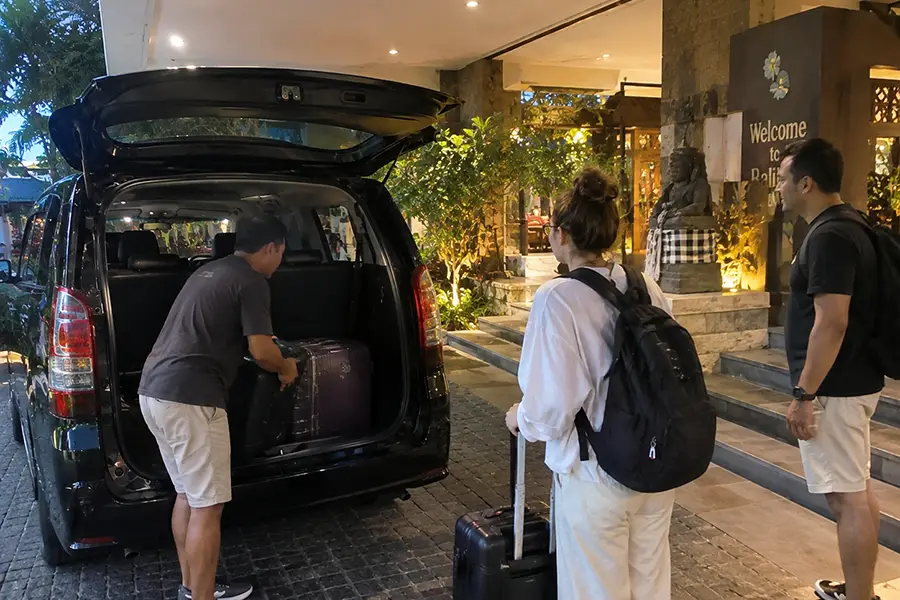
An evening arrival does not need a sightseeing itinerary.
If you land after sunset, the most useful sequence is usually:
Airport → accommodation → check-in → dinner → sleep
This is particularly sensible after a long international flight.
Trying to add sightseeing after an evening arrival can create unnecessary complications. Attractions may be closed, roads may be busy, and you still need to complete your accommodation check-in.
If you arrive around dinner time, choose somewhere near your hotel rather than making another long journey for a particular restaurant.
Late-night arrival
For a late-night arrival, prioritise:
- Confirming the accommodation accepts late arrivals.
- Checking how the property handles after-hours check-in.
- Keeping your booking details accessible.
- Arranging transport before leaving the airport.
- Knowing where you will meet the driver.
- Having essentials such as water, medication and chargers accessible in your hand luggage.
Ngurah Rai Airport has designated arrival and pickup areas for passengers leaving the terminal.
If you are arriving very late, the first day may effectively be a travel day. That is perfectly reasonable. Your sightseeing can start after breakfast the following morning.
Plan Around Your Luggage
Luggage is one of the easiest things to overlook when creating a Bali arrival day itinerary.
A plan that looks convenient on a map may become inconvenient when you have two large suitcases, cabin bags and a travel companion who needs somewhere to sit and rest.
Ngurah Rai Airport provides baggage trolleys in the baggage claim area. Its official arrival guidance also notes that passengers can contact airline staff at Lost and Found if baggage does not arrive.
If you have large suitcases
Going directly to your accommodation is usually simpler.
If you want to stop somewhere before check-in, confirm in advance that your transport arrangement can accommodate the stop and that your luggage can remain safely with you.
Do not build your first day around repeatedly unloading and reloading bags.
If your hotel can store luggage
A luggage-storage option gives you more flexibility.
For example:
Airport → hotel luggage drop → lunch → nearby sightseeing → return for check-in
This can work particularly well when the hotel is conveniently located and the activity is nearby.
However, confirm the hotel’s luggage-storage and early-arrival arrangements before relying on them.
[FACT CHECK REQUIRED: Confirm individual hotel policies, early check-in availability and luggage-storage policies before publication if specific properties are named.]
Account for Bali Traffic
Traffic should be treated as a planning variable rather than a precise travel-time calculation.
Indonesia Travel notes that Bali’s populated areas can experience heavy congestion during peak periods and that ceremonial processions can sometimes occupy roads.
That matters particularly on arrival day because a delay at one point in the itinerary can affect everything that follows.
For example:
Flight delay → later airport exit → later departure → slower road journey → missed check-in expectation → rushed dinner plan
The solution is not to predict traffic perfectly. It is to leave enough flexibility.
Build buffers between fixed commitments
Avoid scheduling a prepaid or timed activity immediately after your expected airport arrival unless the cancellation and arrival conditions make that risk acceptable.
Your hotel check-in is also a useful anchor. Once you have reached the accommodation, you have removed one of the biggest uncertainties from the day.
Private transport as an enabler
Private transport can be useful when your arrival itinerary has several practical requirements: luggage, a fixed accommodation, a meal stop or one planned activity.
The point is not that every traveller needs a private driver. It is that having transport arranged can make the itinerary easier to adjust around the actual time you leave the airport.
For a later sightseeing day, travellers who want more freedom between destinations may also consider car rental with a driver in Bali rather than arranging each individual transfer.
Match the Itinerary to Your Energy
The most important variable is often not distance. It is energy.
A traveller arriving after a short regional flight may be ready for lunch and sightseeing. Someone arriving after an overnight international flight may prefer a shower and a bed.
Consider:
- How long you were travelling.
- Whether you slept on the flight.
- Whether you are travelling with children.
- Whether you have mobility requirements.
- How much luggage you have.
- Whether you need medication or regular meals.
- Whether you have another early start the following day.
A first day with only one activity can still be a successful Bali itinerary.
You do not need to visit several attractions simply because you have arrived in Bali.
A Practical First-Day Itinerary by Arrival Time
If you want a quick planning reference, use this framework:
Morning arrival
Best for: Travellers with reasonable energy and flexible check-in.
Plan: Airport → breakfast → one nearby activity → hotel → rest → dinner.
Avoid: Multiple distant attractions before check-in.
Midday arrival
Best for: Travellers who want a useful but relaxed first day.
Plan: Airport → lunch → hotel → check-in → rest → nearby activity.
Avoid: Long cross-island sightseeing immediately after landing.
Afternoon arrival
Best for: Travellers who want a simple introduction to Bali.
Plan: Airport → hotel → settle in → sunset or nearby outing → dinner.
Avoid: Time-sensitive attractions far from your accommodation.
Evening arrival
Best for: Travellers prioritising rest.
Plan: Airport → hotel → check-in → dinner → sleep.
Avoid: Building a sightseeing schedule around attractions that may already be closing.
Bali Airport Sightseeing Transfer: When Does It Make Sense?
A Bali airport sightseeing transfer can make sense when you have a meaningful amount of time before hotel check-in and your planned stop is genuinely on the route.
For example, a traveller with a morning arrival might prefer:
Airport → breakfast → one attraction → hotel
rather than:
Airport → hotel → wait → return to the same area
But this only works when the stop fits the route and the traveller has enough energy.
It is less suitable when:
- Your flight arrives late.
- You are travelling with substantial luggage.
- Your hotel is far from the airport.
- You have a strict check-in or booking time.
- Traffic conditions are uncertain.
- You are arriving after a long overnight flight.
Think of sightseeing transport as an option that supports the itinerary, not as a reason to add more stops.
Booking Checklist for Your First Day in Bali
Before you confirm your arrival-day plan, check these details.
1. Confirm your scheduled landing time
Use the latest flight information available and leave room for delays.
2. Identify your arrival terminal
Domestic and international arrival procedures differ, so make sure your driver and accommodation information matches your flight.
3. Estimate your airport exit time
Do not use the aircraft landing time as your pickup-ready time. International arrivals need to complete immigration, baggage and customs before exiting.
4. Confirm the pickup arrangement
Know where you are expected to meet your driver and what information you should look for after leaving the terminal.
5. Check your luggage situation
Decide whether you are going directly to the hotel or travelling with your bags to another stop.
6. Confirm hotel check-in
If you arrive before standard check-in, ask whether luggage can be stored while you wait.
7. Check the route
Look at your accommodation and proposed activity on the same map. A short-looking distance can take considerably longer when traffic is heavy.
8. Keep the first activity optional
If your flight is delayed or you are exhausted, remove the activity rather than forcing it into the schedule.
9. Avoid overbooking the evening
Your first Bali dinner does not need to be across the island. Choose convenience if you are tired.
10. Recheck special arrangements
If you need a child seat, mobility assistance, extra luggage space, a particular vehicle type or another service requirement, confirm it with the provider before travel.
[FACT CHECK REQUIRED: Confirm any provider-specific pickup rules, waiting policies, vehicle specifications, child-seat availability or special-service availability before publication.]
Frequently Asked Questions
What should I do immediately after landing in Bali?
Complete the required arrival procedures, collect your luggage and leave the airport before starting your sightseeing plan. For international arrivals, this includes immigration, baggage collection and customs.
Can I go sightseeing immediately after arriving in Bali?
Yes, particularly with a morning arrival, but keep the first activity light and allow enough time for airport procedures, luggage and traffic. Going directly to your hotel may be a better option after a long flight.
How many activities should I plan for my first day in Bali?
For most travellers, one main activity is enough if you arrive in the morning or afternoon. With an evening arrival, you may be better off doing no sightseeing at all.
Should I go straight to my hotel from Bali Airport?
Going directly to your accommodation is often the simplest choice, especially if you have large bags, arrive late, travel with children or have had a long flight. If you arrive early, you can ask the hotel about luggage storage and use the waiting period for lunch or one nearby activity.
Is private transport useful on the first day?
It can be useful when you have luggage, a specific accommodation destination or a planned stop before check-in. The main benefit is having transport that can fit around the practical sequence of your arrival day rather than adding activities simply to fill time.
What if my flight arrives late?
Reduce the itinerary. After immigration, baggage collection, customs and the journey to your accommodation, prioritise check-in, food and rest. Move sightseeing to the following day rather than creating a rushed evening schedule.