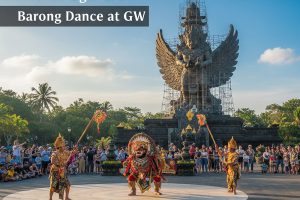


When visitors see the Garuda Wisnu Kencana statue rising above the Bukit Peninsula, the scale tends to stop them in their tracks. At 121 meters, it’s one of the tallest statues in the world. But what holds attention longer than the size is what it represents — a deeply layered symbol of Balinese Hindu belief, Indonesian cultural identity, and two decades of artistic and engineering commitment that went into building it.
The Garuda Wisnu Kencana Cultural Park surrounding the statue is a 60-hectare complex that functions as a living centre for Balinese art, performance, and ceremony. This guide covers the meaning behind the monument, what to expect during a visit, and how to make the most of your time here.

The meaning behind Garuda Wisnu Kencana
The statue depicts the Hindu deity Vishnu — known as Wisnu in Balinese culture — riding the mythological bird Garuda. In Hindu belief, Vishnu is the guardian of the universe, responsible for maintaining cosmic order. Garuda is celebrated for his unwavering loyalty and his act of rescuing his mother from bondage — a story of devotion and sacrifice that carries significant weight in Balinese tradition.
Together, the two figures represent harmony, courage, and protection. These are not abstract concepts in Bali — they are values woven into daily life, from temple ceremonies to the structure of traditional villages. The statue gives those values a physical, permanent form on the landscape.
Beyond Bali, GWK has become a symbol of Indonesian national identity. As a representation of Hindu mythology in a diverse nation, it stands as an expression of cultural coexistence and spiritual heritage. It has been used in state events, educational programmes, and cultural diplomacy, which gives it a significance that extends well beyond its role as a tourist attraction.
A Living Cultural Park
Performances and ceremonies
The park hosts daily traditional Balinese dance performances including the Barong and Kecak. These are not purely commercial shows — they draw on ritual traditions that have been performed for centuries, and watching them in the context of the park gives them a weight that a hotel lobby performance doesn’t quite match. The park also hosts religious ceremonies and temple offerings, particularly during significant dates in the Balinese calendar. If you’re interested in the broader range of Balinese performing arts, the Calonarang dance is another compelling performance rooted in Balinese spiritual tradition worth seeking out during your stay.
Craftsmanship and art exhibitions
The park regularly features art exhibitions, sculpture displays, and cultural workshops. Woodcarving, batik painting, and traditional craft demonstrations give visitors a hands-on engagement with Balinese artisan traditions. The focus is on active participation, not passive observation.
Architectural and engineering achievement
The statue was designed by Indonesia’s renowned sculptor Nyoman Nuarta and took over two decades to complete. It was built using more than 3,000 tons of copper and brass, engineered to withstand earthquakes and extreme weather. Every detail — the span of Garuda’s wings, the expression on Vishnu’s face — was designed with both cultural accuracy and long-term durability in mind. The construction story itself is one of national commitment to preserving heritage through monumental art.
Best Time to Visit and What to Expect
Morning visits offer cooler temperatures and less crowding — the statue and grounds are clearest before midday. Evening visits during festival periods offer a different experience: traditional performances under lighting with the monument as backdrop. The Lotus Pond venue within the park is used for larger events and cultural shows and is worth checking the schedule for.
On-site restaurants serve local Balinese dishes, and exhibition halls provide additional context on the history and construction of the monument. Plan for at least two to three hours if you want to take in the performances and explore the full grounds.
GWK Cultural Park is located in the Bukit Peninsula, roughly 20 minutes from Ngurah Rai International Airport. Arranging a Bali airport transfer that includes a GWK stop is a practical way to visit on arrival or departure day without adding separate transport logistics. The park is also close to Uluwatu, Jimbaran, and the beaches of Ungasan — making it easy to anchor a full South Bali day around it. Balangan Beach in Ungasan is a natural add-on for the afternoon after a morning at GWK.

Plan your GWK visit with Bali Touristic
Garuda Wisnu Kencana is the kind of site that rewards knowing what you’re looking at. A local guide adds real depth to the experience — the mythology, the construction history, the significance of the ceremonies — in a way that walking around independently doesn’t quite replicate.
If you’d like to include GWK in a wider South Bali itinerary with transport and guided context, our Bali tour package options can put that together — flexible scheduling, private transport, and guides who know the site well. See what past travellers have said on Tripadvisor.

Frequently Asked Questions
What is the Garuda Wisnu Kencana statue?
Garuda Wisnu Kencana is a 121-meter statue of the Hindu deity Vishnu riding the mythological bird Garuda, located on the Bukit Peninsula in Badung, Bali. It is one of the tallest statues in the world and the centrepiece of the GWK Cultural Park.
Who designed the Garuda Wisnu Kencana statue?
The statue was designed by Indonesian sculptor Nyoman Nuarta. Construction spanned over two decades and used more than 3,000 tons of copper and brass. It was completed and officially opened in 2018.
What can you do at GWK Cultural Park?
The park offers traditional Balinese dance performances (including Barong and Kecak), cultural workshops, art exhibitions, sculpture displays, dining, and views of the monument. Religious ceremonies and larger events are also held at the Lotus Pond venue within the park grounds.
What is the best time to visit GWK?
Morning visits are cooler and less crowded. Evening visits during festival periods offer traditional performances with the monument lit up as a backdrop. Check the park’s performance schedule before visiting to time your arrival around a show.
How far is GWK from Ngurah Rai International Airport?
GWK Cultural Park is approximately 20 minutes from Ngurah Rai International Airport by car. It sits in the Bukit Peninsula near Jimbaran and is close to other South Bali attractions including Uluwatu Temple and the beaches of Ungasan.
Is GWK worth visiting for non-Hindu travellers?
Yes. While the site has deep significance in Balinese Hindu tradition, the park is designed to be accessible and informative for visitors of all backgrounds. The performances, craftsmanship exhibitions, and the engineering achievement of the statue itself offer value regardless of prior familiarity with Hindu mythology.