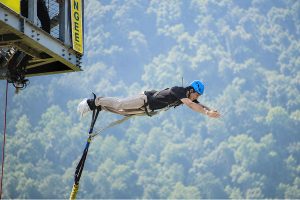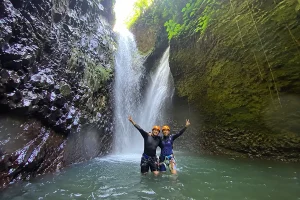

Sambangan Waterfall is one of North Bali’s best kept secrets, tucked inside a lush valley where seven separate falls wait along a single forest trail. Because the trek connects all seven falls in one route, it gives you more variety than almost any other waterfall visit on the island.
The village sits quietly away from the busier tourist areas. Rice fields and tall trees surround it, so the air stays cool and the pace stays slow. Many visitors compare Sambangan Waterfall to a secret garden that nature has kept hidden from the crowds.

Why Sambangan Waterfall Is Unique for Waterfall Trekking
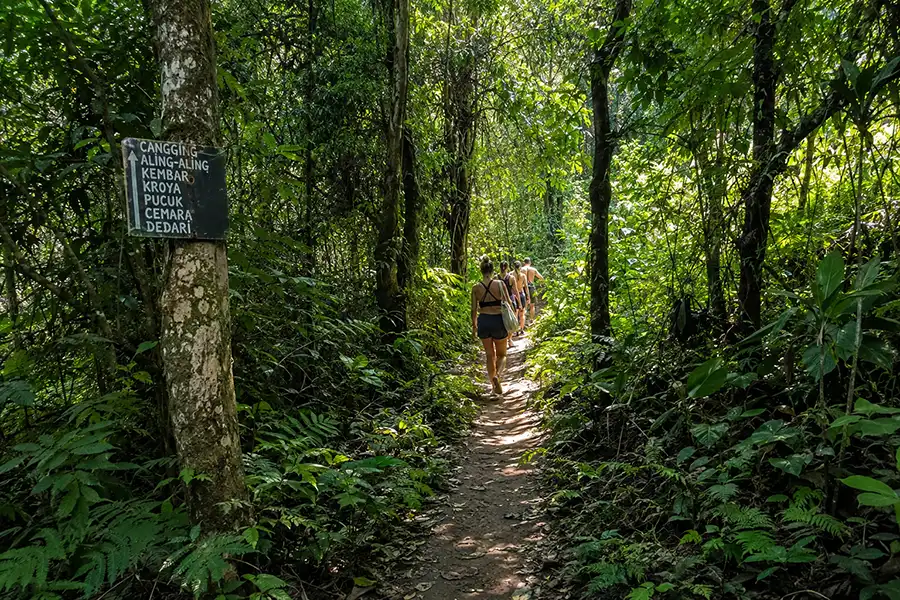
Sambangan Waterfall stands out because you never walk a flat, ordinary path. Instead, you cross soft earth, small bamboo bridges, and shaded forest trails that change with every turn.
Along the way, birdsong, splashing water, and the wind create a soundtrack that feels completely natural. Because the trail still feels wild, many travelers say it delivers a more authentic experience than the busier waterfalls further south.
Seven Waterfalls Bali makes the trek even more rewarding, since every stop offers something new. If you want a taste of what waits ahead, the Best Hidden Waterfalls Trip in Ubud gives you a preview of similar hidden falls before you even set foot on the trail.
Why Seven Waterfalls Bali Is Worth Visiting
Seven Waterfalls Bali earns its reputation because every fall has its own character, even though they sit close together. No two look alike, and that variety keeps the trek interesting from start to finish.
Some falls drop from great heights, others spread wide across the rock, and a few create calm pools perfect for swimming. Because each stop feels different, your visit to Sambangan Waterfall never feels repetitive.
Sambangan Waterfall Entrance Fee and Opening Hours
Sambangan Waterfall charges a small entrance fee for general viewing, usually between IDR 10,000 and IDR 20,000 per person. If you want to swim, slide, or jump, you will need one of the guided trekking packages instead, since a local guide leads every water activity for safety.
Prices vary slightly between operators, so treat the numbers below as a general guide rather than a fixed rate.
| Package | Waterfalls Included | Approximate Price | Duration |
| Viewing Only | Walk around the entrance area | IDR 10,000 – 20,000 | 30 – 60 minutes |
| Short Trek | Canging, Dedari, Cemara (3 falls) | IDR 125,000 | 2 – 3 hours |
| Medium Trek | Aling-Aling, Kroya, Kembar, Pucuk (4 falls) | IDR 250,000 | 3 – 4 hours |
| Long Trek | All 7 waterfalls combined | IDR 375,000 – 500,000 | 6 – 8 hours |
Sambangan Waterfall usually opens daily from around 8 in the morning until 5 in the evening, though hours can shift slightly by season. Most guides recommend starting your trek between 7 and 9 AM, since the early hours bring cooler air and softer light for photos.
How to Get to Sambangan Waterfall
Sambangan Waterfall sits in Buleleng Regency, in the village of Sambangan near Sukasada. From Denpasar or the southern resort areas, the drive takes about two to three hours, covering roughly 80 to 90 kilometers of mountain roads.
Because the route winds through hills and narrow village roads, many travelers prefer hiring a private driver rather than self driving. A local driver already knows the turns, the parking area, and the best pickup time, so your day starts smoothly instead of stressfully.
Waterfalls You Will See on the Sambangan Trek
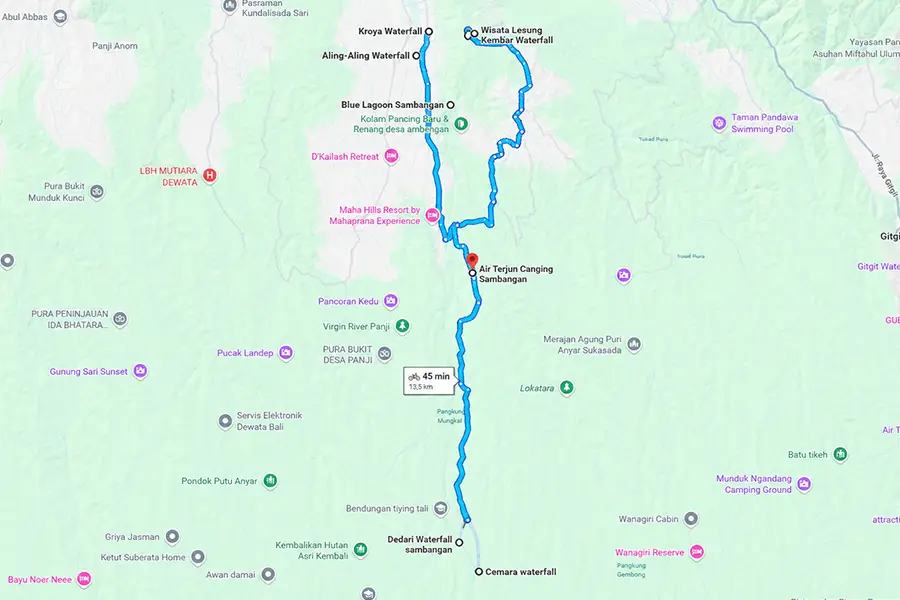
The Sambangan Waterfall complex holds exactly seven falls, each with its own height, character, and story. Here they are in the order most guides follow.
1. Canging Waterfall
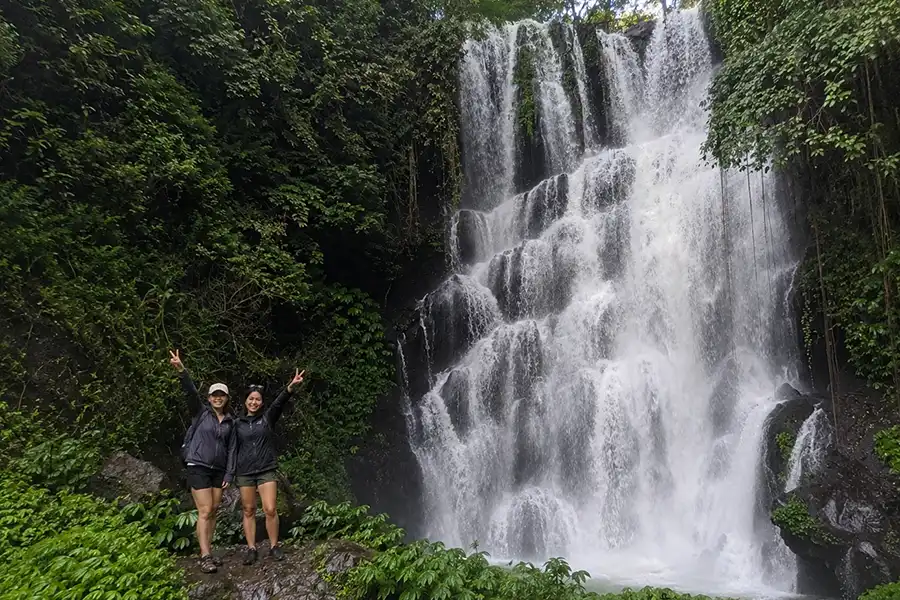
Your trip usually starts near Canging Waterfall, a gentle six meter drop that works as a soft welcome from nature. Locals named it after the large tree roots that spread across the rock face beside the water. A wooden bridge connects this spot to Dedari Waterfall further down the trail, so many travelers enjoy splashing their faces here before moving on, since the water feels refreshingly cool and the current stays calm. Canging is one of the three falls included in the Short Trek package, and swimming here is welcome since no jumping or sliding takes place at this stop.
2. Aling-Aling Waterfall
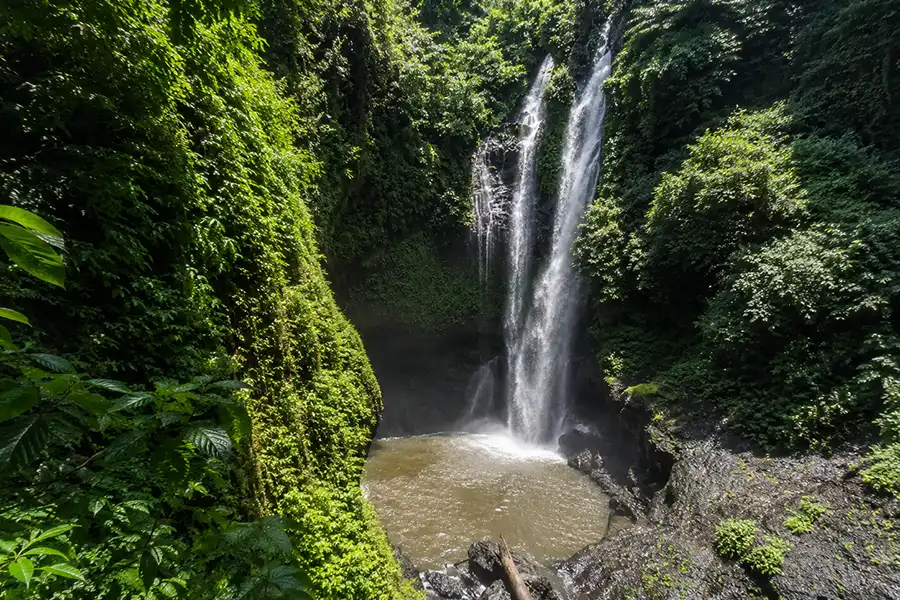
Not long after, you reach Aling-Aling Waterfall, the tallest fall in the complex at around 35 meters. Because the current runs strong at the base, swimming directly under the main fall is not recommended, and a guide will always be with you here. Instead, most visitors love it for the natural slide that sits right beside the waterfall. You cannot slide down the main fall itself, but the safe slide area next to it becomes a fun playground for most travelers, and a guide will help you enjoy it safely. Along with Kroya, Kembar, and Pucuk, Aling-Aling is one of the four falls featured in the Medium Trek package, where most of the jumping and sliding activity happens.
3. Kembar Waterfall
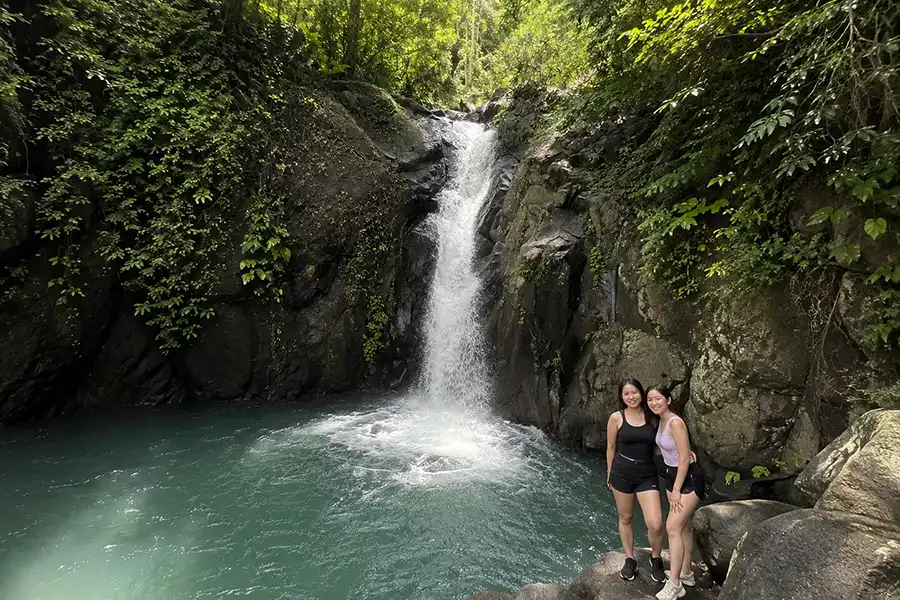
The next stop is Kembar Waterfall, also called Twin Waterfall since two separate falls drop side by side into the same pool. The taller stream measures around 16 meters, while the smaller one drops about 10 meters and doubles as a popular cliff jumping spot supervised by your guide. Because both falls share one pool, the twin shape gives the whole area a striking, balanced look that photographs beautifully, which is exactly why it has become a favorite backdrop for pre wedding photography among Balinese couples.
4. Kroya Waterfall
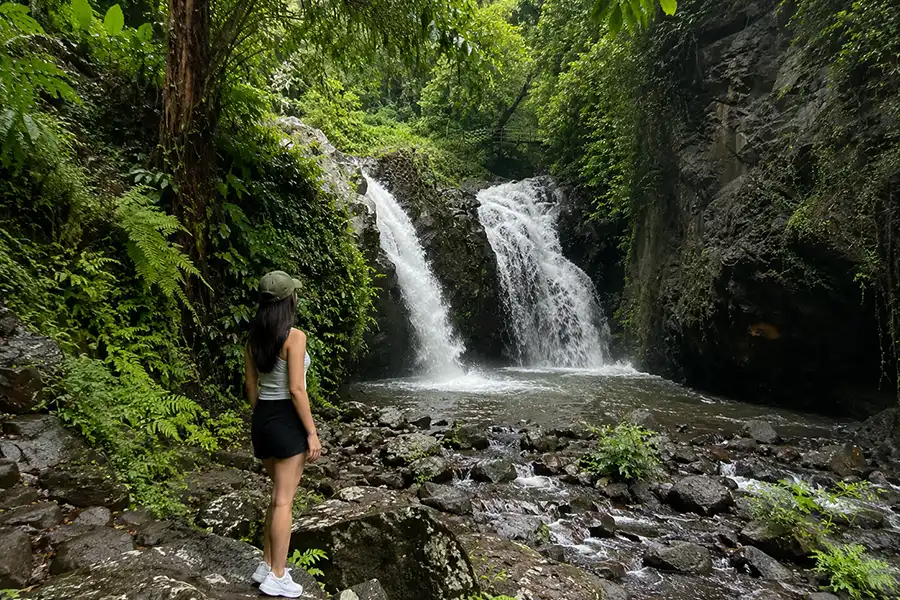
Right after that, you reach Kroya Waterfall, named after a tropical Kroya tree that grows nearby. Guides often treat it as a warm up jump, since the platform sits around five meters above the pool, lower and gentler than some of the other jumps on the trek. Many travelers call this stop the most thrilling part of the day, though you can always skip the jump and simply enjoy the view instead, since standing back to watch is just as welcome as taking the leap yourself.
5. Pucuk Waterfall
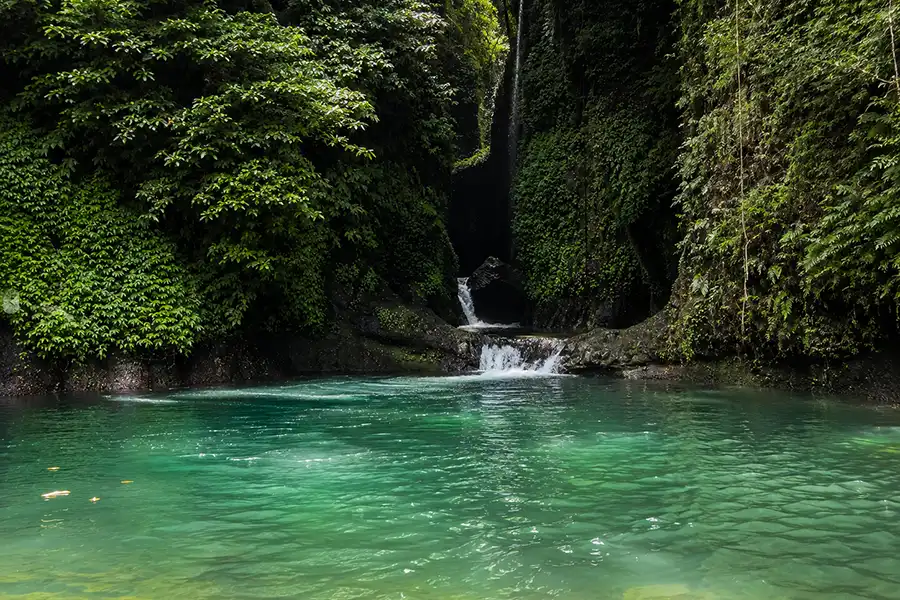
After Kroya, the path leads to Pucuk Waterfall, which drops roughly 15 to 16 meters straight down a tall cliff into a calm pool. It often serves as the final and highest jump of the trek, so guides usually save it for travelers who already feel comfortable after the earlier, smaller jumps at Kroya and Kembar. Even without jumping, the pool itself stays gentle enough for a relaxed swim, making Pucuk a satisfying finish to the Medium Trek route before the path continues toward the remaining falls on the Long Trek.
6. Cemara Waterfall
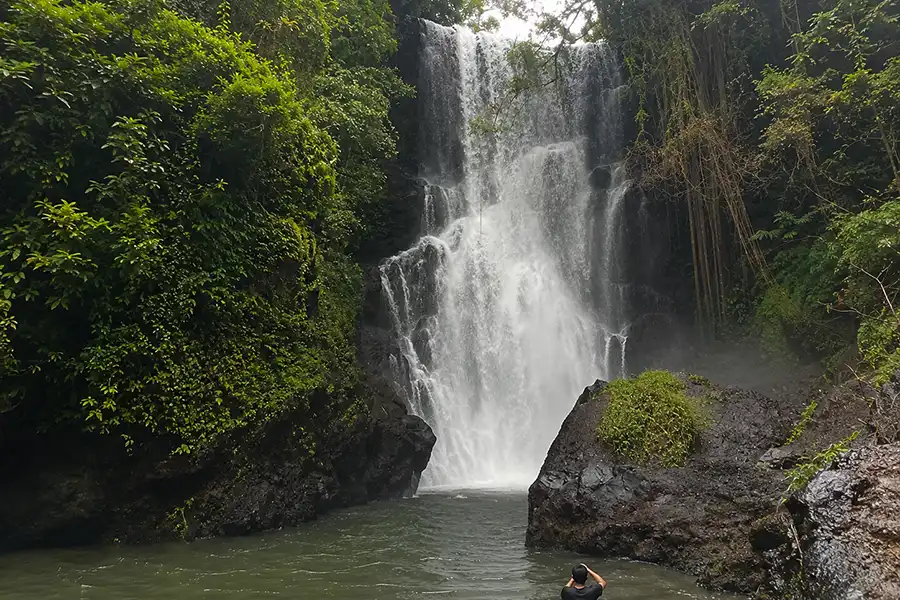
Next, you might walk to Cemara Waterfall, named after the cemara or pine trees that once grew thickly around the site. Some sources list it among the tallest falls in the complex, at close to 35 meters, and it looks like a slim curtain made of countless thin water threads. A natural pool known locally as the Blue Lagoon sits just above it, and dense trees around the area give the whole spot a private, peaceful atmosphere well suited for a quiet swim rather than any jumping or sliding.
7. Dedari Waterfall
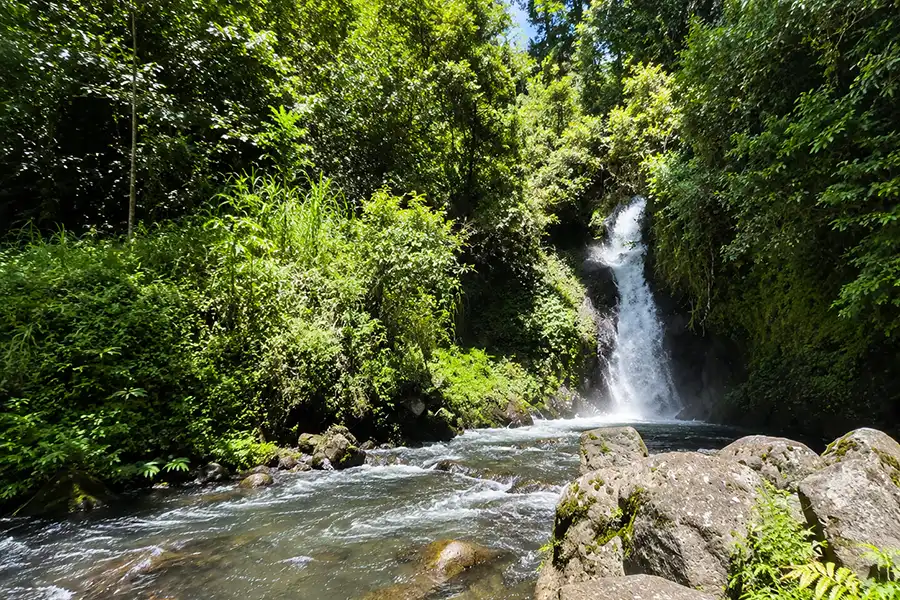
Your final stop is Dedari Waterfall, a roughly 25 meter drop whose name comes from the local word for angel. Local legend says angels once bathed here, and some villagers still believe washing your face with the water keeps you looking young. Many guides call it the fairy waterfall, since the mist sometimes sparkles like tiny lights when sunlight hits it, offering a beautiful ending to the Seven Waterfalls Bali experience. Together with Canging and Cemara, Dedari rounds out the gentler Short Trek package, so travelers who skip the jumping falls still get a complete, memorable route.
Fun Facts You Should Know About Sambangan Trek Bali
Locals call Sambangan the Blue Village, since the water here looks remarkably clear and bright. Beyond that nickname, a few details make this village more interesting than a typical waterfall stop.
- Sambangan still earns its Secret Village nickname because large scale tourism development never reached this remote mountain area, unlike the busier beach towns further south. Many corners of the village still look the same as they did decades ago.
- The pools stay cold year round because natural mountain springs feed the falls, rather than seasonal rainfall runoff. That means the water keeps its chill even in the middle of the dry season, when temperatures elsewhere in Bali climb the highest.
- Several highland bird species live in the forest canopy along the trail, and many of them rarely appear in the busier, more built up areas of South Bali. Bring binoculars if birdwatching interests you, since guides often know where to spot them.
- Long before it became a tourist trail, local farmers used these same forest paths simply to reach their rice fields, along with plantations of clove, coffee, cacao, and banana that still grow along the route today. Some farmers still walk the trail daily for that same reason.
- Most trekking guides come from Sambangan village itself, trained locally rather than through outside tour agencies. That keeps tourism income inside the community and gives visitors a genuinely local perspective on the area’s plants, history, and culture.
- Kembar Waterfall’s two symmetrical drops have made it one of the most requested backdrops for Balinese pre wedding photography, thanks to the balanced, mirror like frame the twin falls create.
Trekking Tips for Sambangan Trek Bali
The trek is not too difficult, but visiting all Seven Waterfalls Bali still calls for real preparation, not just a water bottle and a smile. Here is what actually makes a difference on the trail.
- Expect uneven forest paths, stone steps, and shallow water crossings, so a reasonable level of fitness helps even though most healthy adults manage the trek without trouble.
- Wear closed shoes with good grip rather than sandals, since sections of the trail turn muddy or slippery after rain, and the rocks near the falls can be sharp underfoot.
- Always trek with a licensed local guide instead of exploring alone, since they know the safe entry points for jumping and sliding and will adjust the route if water levels rise unexpectedly.
- Avoid visiting right after heavy rain if possible, since the trail can flood quickly and the current at falls like Aling-Aling can become too strong for safe swimming or jumping.
- Many operators require a minimum of two travelers per booking, so solo travelers may need to join a shared group or pay a small solo surcharge.
- Pack a waterproof bag for your phone and valuables, sunscreen, insect repellent, and a light snack, since food stalls near the trailhead stay limited.
- Morning light offers the best photography conditions, particularly at Dedari Waterfall, where the mist catches the early sun and creates the sparkling effect many guides talk about.
Because the trail mixes water crossings and forest terrain, this kind of preparation goes a long way toward making the day feel exciting instead of exhausting.
Best Time to Visit Sambangan Waterfall
Most travelers prefer the early morning, when the air stays cool and sunlight filters gently through the trees. Guides usually recommend starting between 7 and 9 AM.
Bali has both a wet season and a dry season, yet Sambangan Waterfall stays open for trekking year round. That said, the dry season offers easier trails and clearer water, so it remains the more popular choice.
Sambangan Trek Packages and Options
Trekking packages generally fall into three tiers, though some operators add a fourth for advanced routes. The table below shows exactly which waterfalls each package covers, so you know what you are booking before you commit.
| Package | Waterfalls Included | Duration | Activity Level |
| Short Trek | Canging, Dedari, Cemara Waterfall | 2 – 3 hours | Easy walking and swimming, no jumping or sliding |
| Medium Trek | Aling-Aling, Kroya, Kembar, Pucuk Waterfall | 3 – 4 hours | Includes guided cliff jumping and natural slides |
| Long Trek | All 7 waterfalls (Short and Medium combined) | 6 – 8 hours | Full mix of walking, swimming, jumping, and sliding |
Prices usually include a guide, and many operators also provide drinking water, life jackets, and safety equipment. If you want the calmer falls without any jumping, the Short Trek covers it. If the adventure activities are the main draw, the Medium Trek gets you straight to them without the extra walking time the Long Trek requires.
What Makes This Sambangan Trek Special
Sambangan feels unique because its falls sit close together yet still look completely different from one another. The trail is not too hard, and it is not too easy either, which makes it ideal for travelers who want adventure without unnecessary stress.
Seven Waterfalls Bali packs a surprising range of landscapes into one route. You will pass tall cliffs, forest paths, river rocks, natural water slides, and peaceful swimming pools.
Because this trail still receives fewer visitors than other Bali attractions, the atmosphere feels calmer throughout. Many travelers say the trek leaves them feeling more connected to nature than almost anywhere else on the island.
What to Do After Trekking
After finishing the trek, most visitors feel refreshed and ready to relax. Many stop at a small local coffee shop near the village to enjoy coffee or fresh coconut while looking out over the rice fields.
If you want to keep exploring Bali afterward, browsing a trusted Bali Tour Package can help you add more destinations to the rest of your day. It is a simple, satisfying way to close out your Sambangan Waterfall adventure.
Other Hidden Waterfalls to Explore in Bali
If Sambangan Waterfall leaves you wanting more, Bali has several other hidden falls worth the detour.
Waterfalls near Ubud and east Bali
In Bangli, tibumana waterfall offers twin cascading streams inside a quiet forest, about two hours from Seminyak or Kuta. Its hidden cave and peaceful setting make it a favorite for travelers who want to escape the crowds.
Further east in Klungkung, tukad tista waterfall drops about 15 meters into a pristine pool surrounded by dense jungle. Because it stays off the typical tourist route, the area remains calm even during peak season.
More hidden waterfalls around Gianyar
Near Ubud, ulu petanu waterfall carries both natural beauty and local legend, tied to the story of a Balinese king who once used the site for meditation. Its 25 meter drop and quiet pool make it another rewarding stop for travelers chasing Bali’s lesser known waterfalls.
Why You Should Use Bali Touristic
Since Sambangan Waterfall sits in North Bali, comfortable transportation makes a real difference. That is why we recommend traveling with Bali Touristic, which provides a private driver, a clean vehicle, and a safe ride straight to Sambangan village.
Our team also knows the area well, which makes the entire journey easier from start to finish. Booking Bali car rental with driver ahead of time means you can skip the stress of navigating unfamiliar mountain roads on your own.
If you would like to compare, you can check reviews on TripAdvisor to see real experiences from other travelers.

Frequently Asked Questions About Sambangan Waterfall
Is Sambangan Waterfall safe for beginners
Yes, the trail stays safe as long as you follow your guide. Guides lead visitors along the easier routes and provide support throughout the trek.
Do I need to swim at every waterfall
No, swimming stays optional throughout the trek. You can choose which spots you want to enjoy and skip the rest.
Can children join the seven waterfalls trek
Yes, children can join as long as an adult supervises them and the group chooses the short or medium trek.
How long does the complete trek take
The full route usually takes between six and eight hours, depending on your pace, the operator, and how long you stay at each waterfall. Some shorter versions run around four to six hours.
What is the entrance fee
Viewing only costs around IDR 10,000 to 20,000 per person, while guided packages that include swimming, sliding, and jumping start at about IDR 125,000. Prices can vary by operator and season, so treat these numbers as a general guide.
What should I bring for the trek
Bring water, a change of clothes, a waterproof bag, sturdy shoes, and a few snacks. Most guides already provide safety equipment as part of the package.
What is the difference between this trek and Blue Lagoon Sambangan Waterfall
This trek covers all seven falls in the area, including Aling-Aling, Kroya, and Dedari, in one long route. Blue Lagoon Sambangan Waterfall refers to one specific pool within the same complex, so it works well as a shorter, standalone visit if you only have time for one stop.