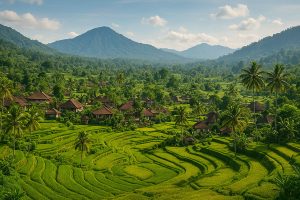

Tenganan Village sits quietly in the hills of East Bali, largely untouched by the rapid development that has transformed much of the island. As one of the last remaining Bali Aga villages, it preserves a way of life that predates the Hindu-Javanese migration to Bali by centuries. Walking through its cobblestone lanes feels like stepping into a living museum of ancient Balinese culture.
Known locally as Tenganan Pegringsingan, the village is celebrated for its geringsing double ikat weaving, the sacred Mekare-Kare pandan war ceremony, and a strict set of customary laws that have kept its traditions intact for generations. For travelers seeking authentic Balinese heritage away from the crowds, Tenganan is a rare gem in East Bali.

What Is Tenganan Village?
Tenganan Pegringsingan is a Bali Aga village, meaning its people are the original, pre-Hindu Balinese. Unlike most communities in Bali, which follow the Hindu-Javanese traditions brought from Java between the 11th and 14th centuries, Bali Aga villages maintained their own ancestral customs. Tenganan is one of the very few where those customs have survived almost entirely intact today.
Visitor Information
📍
Tenganan, Manggis District, Karangasem Regency, East Bali. About 5 km from Candidasa Beach and 65 km from Denpasar.
🕐
Every day, 7:00 AM – 6:00 PM (closed on Nyepi / Balinese Day of Silence)
💰
Free entry. A voluntary donation of IDR 30,000 – 100,000 per person is customary. Village tour package IDR 250,000 (guide + weaving demo + lunch).
🅿️
Available near the entrance. IDR 5,000 for cars, IDR 2,000 for motorcycles.
⏱️
1 to 2 hours for a self-guided walk. Up to half a day if you join a village tour package.
📸
Visit in the morning for soft light and active village life. The cobblestone streets, traditional house gates, and weaving workshops make excellent subjects.

Getting to Tenganan Village
Tenganan Village is located in Karangasem Regency, about 5 km inland from Candidasa Beach and roughly 65 km east of Denpasar. The road to the village is well-maintained, and the drive up through the surrounding hills offers scenic views of rice terraces and traditional rural landscapes. Note that vehicles are not allowed inside the village, so you will park at the entrance.
The most comfortable way to reach Tenganan from central Bali is with a private driver. The trip from Denpasar or Seminyak takes around 2 to 2.5 hours each way. Taxis and ride-hailing apps are generally not available near the village, so booking a car rental with driver in advance is a practical choice. A local driver can also help you combine Tenganan with nearby attractions like Candidasa Beach, Tirta Gangga, or Taman Ujung on the same day.
The History and Mythology of Tenganan
The founding of Tenganan is wrapped in legend. The most widely told story connects the village to the god Bhatara Indra, a sacred horse, and a group of loyal villagers who were rewarded with land in exchange for their devotion.
The legend of the sacred horse
According to local tradition, King Mayadenawa of the Belalu Kingdom once forbade the Peneges villagers from performing religious ceremonies at Besakih Temple. This angered the gods, and Bhatara Indra descended to defeat the king and restore the people’s right to worship. As a celebration, a sacred white-haired horse named Onceswara was to be sacrificed, but the horse mysteriously disappeared. Search parties were sent out across East Bali. One group eventually found the horse dead in the hills. Despite the loss, Bhatara Indra rewarded their loyalty by granting them the surrounding land. The villagers scattered the horse’s remains in all directions to mark their territory, and the place became Tenganan.
An alternative version of the story involves King Udayana of the 11th-century Bedahulu Kingdom, whose magical horse Uccaisrawa was lost and later found dead in the same area. In this version, the king granted the Peneges men a tract of land as a reward for their search. To expand their claim, the men dispersed pieces of the horse across the landscape, knowing the king had promised them all the land where the horse’s scent could be detected. The valley they settled in was called Ngetengahang, meaning “to move to the middle,” which was later shortened to Tenganan.
Sacred stone relics
The horse’s remains are believed to have transformed into megalithic stones, which are still venerated in the village today. Each stone holds a specific ritual significance:
- Kakidukun: Located in the northern part of the village and shaped like a horse phallus. Couples seeking blessings for fertility and children make offerings here.
- Batu Taikik: The largest monolith in the area, perched on the northern hill. Villagers gather here during ceremonies to pray for prosperity and divine blessings.
- Penimbalan: In the western part of the village, this stone is associated with the Teruna Nyoman initiation ceremony for young men.
- Batu Jaran: The site in the north where the sacred horse is said to have died. It is preserved as a memorial to the village’s founding history.
Village Layout and Architecture
Tenganan’s layout is strikingly organized and unlike anything else in Bali. Six parallel rows of cobblestone streets run from north to south through the village, lined with traditional thatched-roof houses and open pavilions. The settlement is enclosed by a surrounding wall, and the entire design follows the Tri Hita Karana philosophy, which emphasizes harmony between people, the natural environment, and the divine.
A small river divides the broader area into two parts. The eastern side is Tenganan Pegringsingan, the main village open to visitors. The western side, called Tenganan Dauh Tukad, is a separate community. Because no vehicles are permitted inside the village, the atmosphere remains uniquely quiet and unhurried.
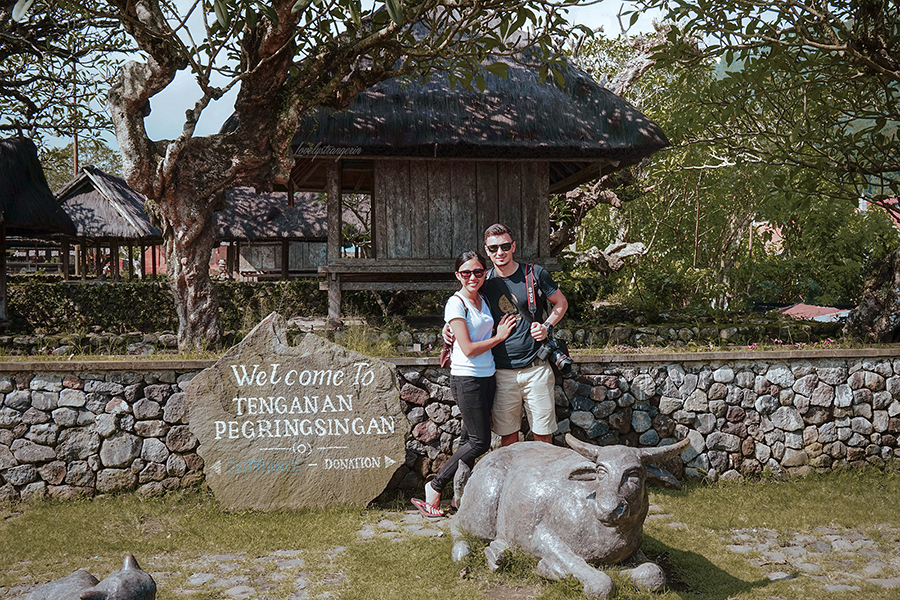
Tenganan traditional houses
Each family compound in Tenganan is built according to the Sanga Mandala concept of space, divided into four main buildings:
- Bale Uga: Located near the main road at the front of the compound. This is the ceremonial pavilion used for religious rituals.
- Bale Tengah: The central building containing two rooms. One is used for death rituals, and the other welcomes newborn babies into the family.
- Bale Meten: A multi-purpose space used as a bedroom and guest room.
- Paon (Kitchen): The cooking area on the south side of the compound, with a bathroom attached to the outer wall.
House entrances are intentionally narrow, wide enough for only one person at a time. Courtyard doors face south, following traditional Balinese spatial principles. Houses are oriented from north to south, reinforcing the village’s disciplined relationship with direction and space.
Culture and Traditions of the Bali Aga People
The Bali Aga, literally meaning “Original Balinese,” have preserved their pre-Hindu customs through a body of communal law called awig-awig. The most well-known rule is the marriage restriction: villagers must marry fellow Tenganan residents. Those who marry outside the village forfeit their right to live there. This practice has been the primary mechanism for preserving the village’s cultural continuity over centuries.
Mekare-Kare pandan war ceremony
The Mekare-Kare ceremony, also called Perang Pandan or the Pandan War, is one of the most striking cultural events in Bali. Held every June or July as part of the annual Usaba Sambah festival, young men from the village engage in a ceremonial fight using bundles of thorny pandan leaves as weapons and rattan shields for protection. The scratches from the thorns are accepted without complaint as a mark of bravery and devotion. After the ceremony, a traditional herbal remedy is applied to the wounds. The ritual is an offering to Bhatara Indra and serves as a coming-of-age tradition for the village’s young men.
Geringsing double ikat weaving
Tenganan is one of only three places in the world where the double ikat textile technique is practiced. The cloth produced here is called geringsing, a word that translates to “repel sickness and dangers.” The technique involves tying and dyeing both the warp and weft threads before weaving begins, creating intricate patterns that require extraordinary precision. A single piece of geringsing can take up to five years to complete.
The geringsing cloth plays a central role in every stage of Bali Aga life. It is used in hair-cutting ceremonies for infants, tooth-filing rituals for adolescents, wedding ceremonies, and finally as a shroud for the body before cremation. The star motifs woven into the cloth represent the divine realm of Indra, who is said to have gifted the weaving technique to the village’s women.
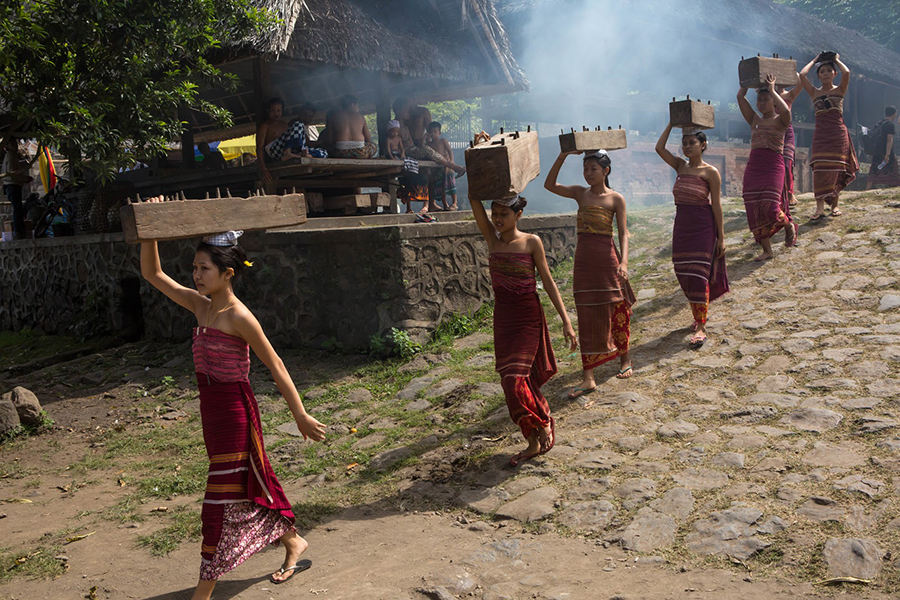
Other crafts, music, and local products
Beyond weaving, Tenganan artisans are skilled in lontar palm leaf etching, basket weaving, woven bamboo art, and palm leaf calligraphy. These crafts are available for purchase in the small shops along the village lanes. Prices are negotiable, though many pieces represent days or weeks of skilled labor.
During your visit, you may also hear the sound of Gamelan Selunding, a rare form of sacred music played on iron metallophones. It is considered one of the oldest musical traditions in Bali and is rarely performed outside of Tenganan. The village also produces a rare black honey harvested from stingless bees, which local sellers offer to visitors.
What to See and Do in Tenganan Village
A visit to Tenganan is best enjoyed at a slow pace. Once inside, a local resident will typically accompany you as an informal guide, included with your donation. Here are the main highlights worth seeking out:
- Northern part of the village: Visit Pura Paseh temple and the sacred stones Kakidukun, Taikik, and Batu Jaran.
- Southern end: Look for the Main Village Gate flanked by two small temples, the Bale Agung longhouse used for communal meetings, and the Kul Kul drum tower that starts each day with 21 drum beats.
- Village center: Open pavilions used for ceremonial gatherings and informal meetings among residents.
- Craft stalls: Browse geringsing textiles, lontar etchings, basketwork, and organic black honey. Polite bargaining is normal, but keep in mind that handwoven geringsing represents years of labor.
- Swing ritual: During the Usaba Sambah season, you may witness the traditional swing ceremony, where young women in ceremonial attire ride a large wooden swing as a symbol of the continuing cycle of life.
Entrance Fee, Tickets, and Opening Hours
There is no fixed entrance fee to enter Tenganan Village. Visitors are invited to leave a voluntary donation at the entrance, with most people contributing between IDR 30,000 and IDR 100,000 per person. After donating, a local resident is typically assigned to guide you through the village. Parking is available near the entrance for a small fee.
| Ticket Type | Price |
| Village entry (all visitors) | Free (suggested donation IDR 30,000 – 100,000) |
| Village tour package (guide + weaving demo + lunch) | IDR 250,000 per person |
| Rice field trekking | IDR 250,000 per person |
| Parking (car) | IDR 5,000 |
| Parking (motorcycle) | IDR 2,000 |
| Day | Opening Hours |
| Every day (except Nyepi) | 7:00 AM – 6:00 PM |
Plan Your Journey with Bali Touristic
Tenganan Village is one of the most culturally rewarding stops on any East Bali itinerary. It pairs naturally with nearby destinations like Candidasa Beach, Tirta Gangga water palace, and the royal water garden at Taman Ujung.
If you prefer a well-organized itinerary, a Bali tour package from Bali Touristic can handle all the logistics, from transport to timing your visit around local ceremonies.
For those who prefer to explore at their own pace, booking a car rental with driver from Bali Touristic gives you the freedom to discover East Bali on your own schedule, with an experienced local driver who knows the roads and can suggest the best stops along the way.

Frequently Asked Questions About Tenganan Village
Where is Tenganan Village located?
Tenganan Village is located in Karangasem Regency, East Bali, in the Manggis District. It sits about 5 km from Candidasa Beach and approximately 65 km east of Denpasar.
Is there an entrance fee for Tenganan Village?
There is no fixed entrance fee. Visitors are asked to leave a voluntary donation at the entrance, typically between IDR 30,000 and IDR 100,000 per person. Parking costs IDR 5,000 for cars and IDR 2,000 for motorcycles.
What are the opening hours of Tenganan Village?
The village is open every day from 7:00 AM to 6:00 PM, except during Nyepi (the Balinese Day of Silence), when all tourism activity stops island-wide.
What is Tenganan Village famous for?
The village is best known for its ancient Bali Aga culture, the geringsing double ikat textile (one of only three places in the world where it is made), and the Mekare-Kare pandan war ceremony held annually in June or July.
What activities can visitors do in Tenganan?
Visitors can explore the village with a local guide, watch artisans at work on geringsing weaving, browse traditional crafts and organic black honey, visit the sacred stone relics and temples, and, when timing allows, witness the pandan war ceremony or the swing ritual.
What is the best time to visit?
Mornings are ideal, when the weather is cooler and village activities are in full swing. To witness the Mekare-Kare pandan war ceremony, plan your trip in June or July during the Usaba Sambah festival.
How do I get to Tenganan Village from Denpasar?
The drive from Denpasar takes about 2 to 2.5 hours. The most convenient option is to book a private driver or a car with driver rental from Bali Touristic, as public transport does not reach the village directly.