
A Bali rainy season airport transfer needs a little more planning than a dry-weather arrival. Heavy rain can affect road conditions, traffic flow, walking between sheltered areas, luggage handling and the time needed to reach your hotel or first activity.
The key is not to predict exactly how long your journey will take. Instead, plan enough flexibility around your arrival, keep luggage protected, confirm where you will meet your driver, and avoid scheduling an important activity too soon after landing.
At I Gusti Ngurah Rai International Airport, arriving passengers follow the normal arrival process through immigration, baggage claim and customs before exiting towards the arrival corridor and pickup area. The airport specifically identifies a pickup zone for vehicles collecting passengers and luggage.
If you are arranging a private Bali airport transfer, the rainy season is a good reason to confirm the practical details before your flight rather than trying to solve them after landing.

What changes during Bali’s rainy season?
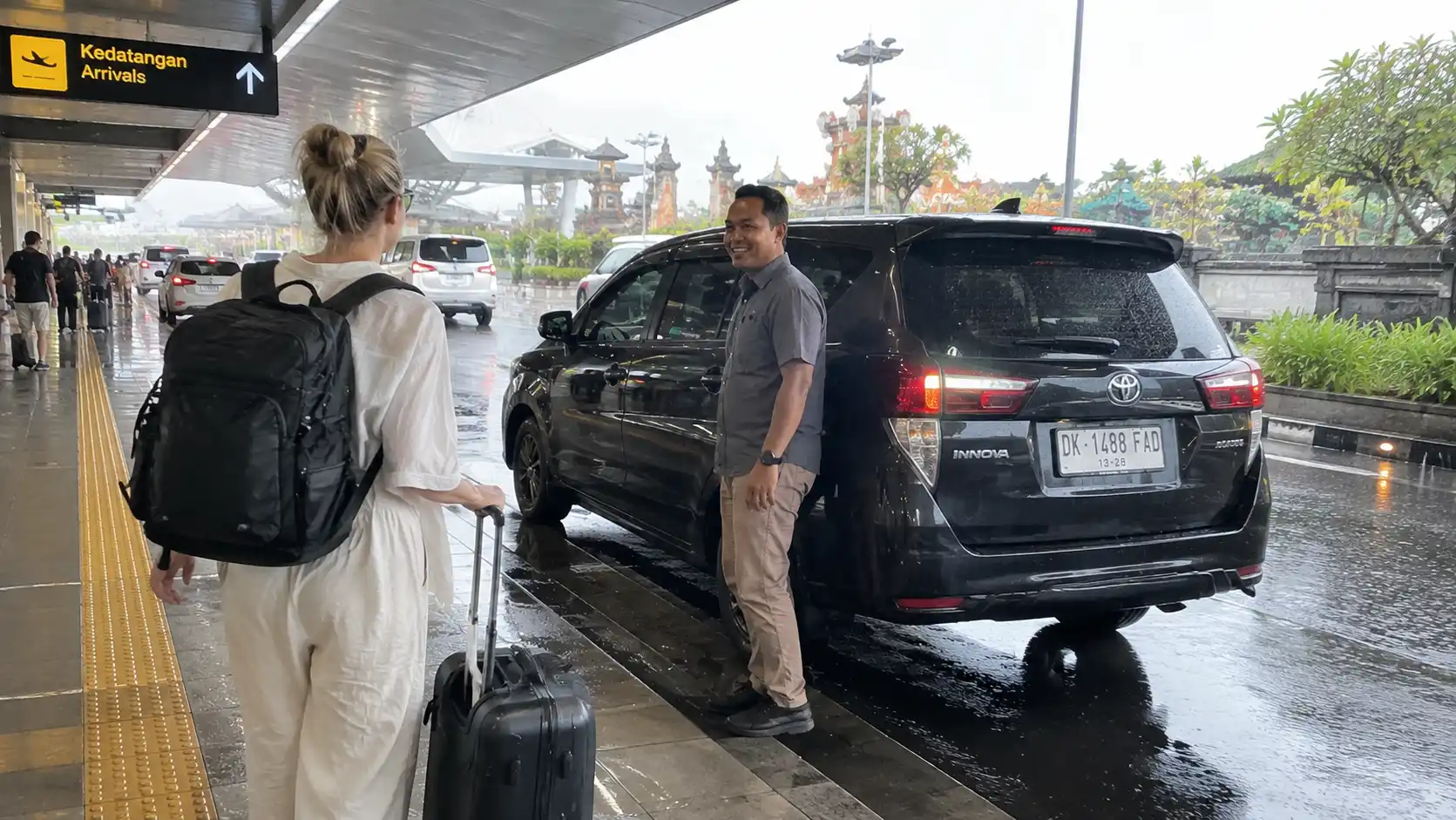
Rain does not mean that every airport transfer will be delayed. Conditions can vary considerably between different parts of the island and even between the airport and your final destination.
For planning purposes, think about rain as one additional variable alongside traffic, flight arrival time, baggage collection and the distance to your accommodation.
Bali’s rainfall also varies by location and month. Official BMKG information shows that rainfall conditions can differ between areas of Bali, so a general statement about the weather across the entire island should not be treated as a forecast for your specific journey.
This is why a useful rainy-season transport plan focuses on what you can control:
- Allowing additional flexibility after landing.
- Protecting luggage from rain.
- Keeping your driver updated if your arrival changes.
- Confirming the agreed meeting point.
- Avoiding a tightly timed activity immediately after airport arrival.
- Checking current weather and traffic information close to travel day.
BMKG regularly updates rainfall analysis and forecasts, so travellers should use current information rather than relying on a generic seasonal prediction made months before travelling.
Bali rainy-season airport pickup: where should you meet?
The pickup arrangement matters more when rain is falling.
Ngurah Rai Airport’s official arrival information describes the Arrival Corridor as an area for meeting and pickup after passengers leave the arrival terminal. It also identifies a designated Pick-up Zone for vehicles collecting passengers and luggage.
However, travellers should not assume that a driver can simply stop anywhere directly outside the terminal.
Confirm the meeting point before you fly
Your booking information should make clear:
- Which arrival terminal you are using.
- Where the driver will meet you.
- How the driver will identify you.
- What contact method you should use if you cannot immediately find each other.
- What to do if your flight is delayed or your baggage takes longer than expected.
Ngurah Rai Airport also has airport transportation facilities and designated pickup arrangements for app-based transport services.
For a pre-booked private transfer, follow the instructions supplied by the transfer provider rather than assuming the meeting procedure is identical to an app-based ride.
Rain can make communication more important
A crowded airport pickup area can become harder to navigate when travellers are carrying umbrellas, pushing luggage or trying to stay under cover.
Keep your phone charged and have the driver’s contact details accessible before landing. If mobile connectivity is uncertain, save the booking information and meeting instructions offline as well.
A simple message such as “We have collected our luggage and are leaving the arrival area now” can make the handover easier when conditions are busy.
Why can rain affect Bali airport transfer times?
There is no reliable single travel time that applies to every rainy-season airport transfer.
The journey depends on several variables, including your destination, departure time, traffic conditions, rainfall intensity, road conditions, accidents or temporary congestion, and the number of stops along the route.
Rain can also affect the journey indirectly. If a shower causes slower traffic on one part of the route, the effect can continue after the rain itself has eased.
Your arrival time still matters
An airport journey during a wet period should be considered in combination with the time of day.
A transfer arriving during a busy traffic period may require more flexibility than the same route at a quieter time. For more detail on how departure time can influence the journey, see our guide to Bali airport traffic planning.
The important point is to avoid turning an estimated journey duration into a fixed promise.
Your destination matters too
A short transfer to an accommodation near the airport and a longer journey towards inland or northern parts of Bali have different exposure to traffic and road conditions.
Routes can also change depending on the destination and current road situation. Your driver may need to adjust the route if congestion develops.
For this reason, a rainy-season airport transfer should be planned around flexibility rather than a precise arrival minute.
Protecting luggage from rain
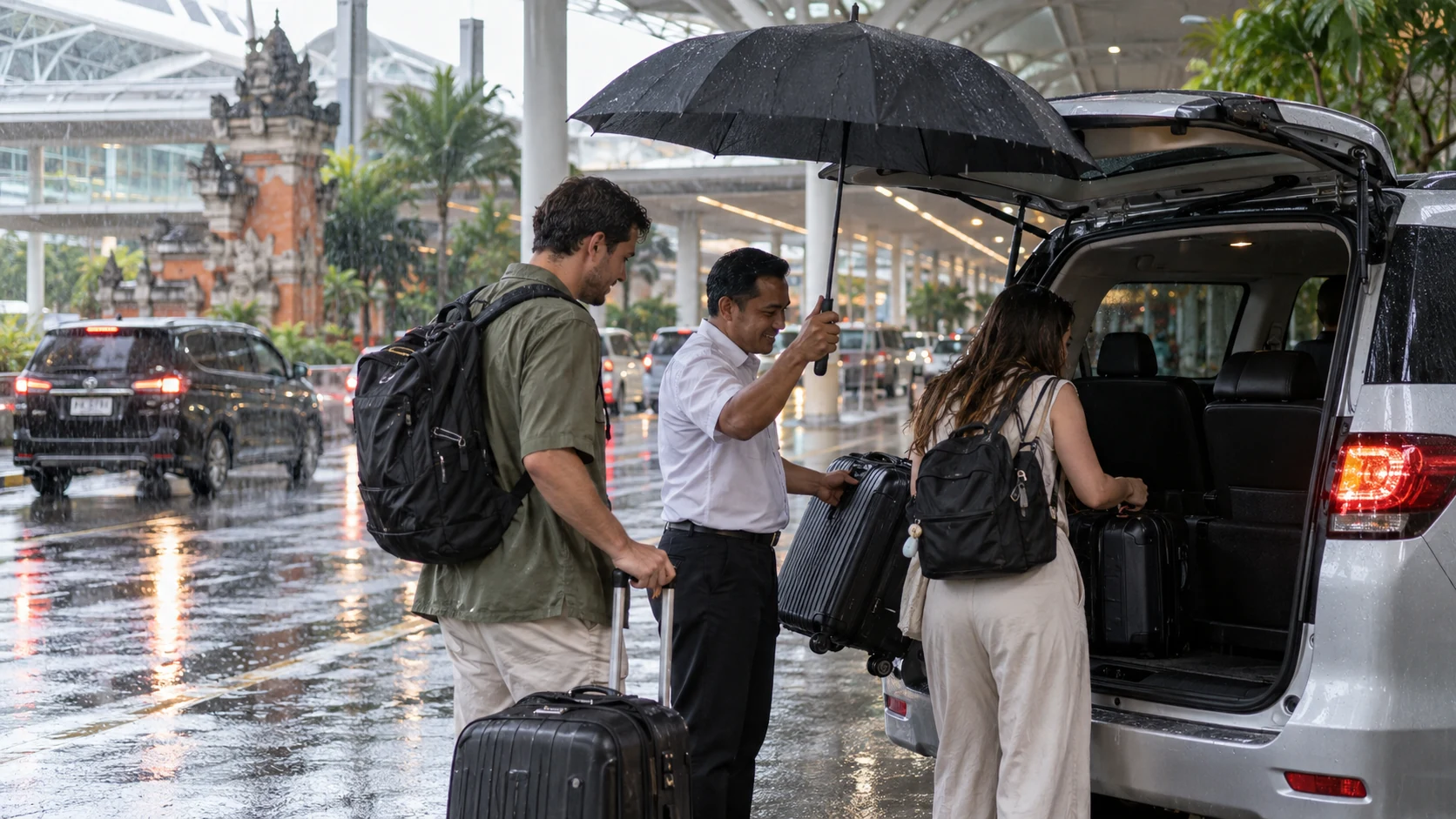
Wet luggage is one of the most avoidable problems during a rainy airport arrival.
The airport provides trolley facilities in the baggage-claim area, which can make it easier to move several bags together before reaching the pickup area.
Still, luggage can be exposed to rain during the transition from terminal to vehicle.
Practical wet-season luggage checklist
Before leaving home, consider:
- Packing electronics and documents inside waterproof pouches or bags.
- Keeping passports and essential travel documents in your hand luggage.
- Using luggage covers if your bags are not water-resistant.
- Keeping one dry change of clothes accessible.
- Separating items that must remain dry from clothes and shoes that can tolerate some moisture.
- Checking that zips and external pockets are properly closed.
- Avoiding unnecessary unpacking during the airport pickup.
A luggage cover is particularly useful because a short walk through heavy rain can be enough to wet the exterior of a suitcase.
If a bag arrives wet or damaged, contact the airline promptly and use the airport’s baggage or Lost and Found procedures where appropriate. The airport’s international arrival guidance directs passengers with missing baggage to their airline’s Lost and Found counter.
Keep your driver updated after landing
Rainy conditions make a clear arrival communication plan more useful.
Your flight’s scheduled landing time is not necessarily the same as the time you will reach the pickup area. International travellers may still need to complete immigration, collect baggage and clear customs before meeting their driver. Ngurah Rai’s official international arrival procedure lists these stages before passengers reach the pickup area.
A useful communication sequence is:
Flight lands → immigration → baggage collection → customs → exit arrival area → contact driver → pickup
If your flight is delayed before departure, use the agreed contact channel to notify the transfer provider as soon as practical.
If the aircraft lands on schedule but baggage collection or airport procedures take longer, there is usually no need to send constant updates. A message once you are ready to leave the arrival area is often the most useful point of contact.
Do not rely on an unverified assumption that a driver will wait for a particular number of minutes. Waiting arrangements can vary between providers and should be confirmed when booking.
Plan your route around the weather
A rainy-day transfer should leave some room for changes.
This does not necessarily mean adding an arbitrary number of hours to every journey. Instead, consider what happens after the airport transfer.
For example, if your flight lands in the afternoon and you have a restaurant reservation later that evening, some flexibility may be sensible. If you have a fixed-ticket activity shortly after landing, the risk is different because a road delay could affect the booking.
Build your plan in layers
A practical approach is:
| Part of the journey | What to plan |
| Flight arrival | Use the scheduled arrival as a starting point, not a guaranteed pickup time |
| Airport procedures | Allow time for immigration, baggage and customs where applicable |
| Pickup | Confirm the exact meeting instructions before departure |
| Road journey | Allow flexibility for traffic and rain-related disruption |
| Hotel arrival | Avoid making an immediate activity dependent on an exact arrival minute |
| First activity | Choose something that can be moved or cancelled if the journey takes longer |
This approach is particularly useful for first-day itineraries.
If the weather or traffic causes a delay, you can adjust the activity rather than feeling that the entire day has gone wrong.
Should you book activities immediately after an airport transfer?
For most travellers, the safest approach is to avoid placing an important, non-refundable activity immediately after your expected hotel arrival.
A rainy-season airport journey has several stages outside your control.
Your flight could arrive later than scheduled. Immigration could take longer than expected. Baggage collection may take time. Rain could slow the road journey. Your accommodation could also take longer to complete check-in.
That does not mean you need to spend your entire first day at the hotel.
Instead, choose activities with flexible timing where possible.
Better options after a wet arrival
Consider:
- A relaxed meal near your accommodation.
- Hotel or villa downtime.
- A flexible café visit.
- An indoor attraction.
- A spa appointment with reasonable timing flexibility.
- Shopping close to your accommodation.
- A short local activity that can be postponed.
Save tightly scheduled tours, boat departures and other time-sensitive bookings for a point in the trip when you have more control over your location.
Have a backup plan for rain
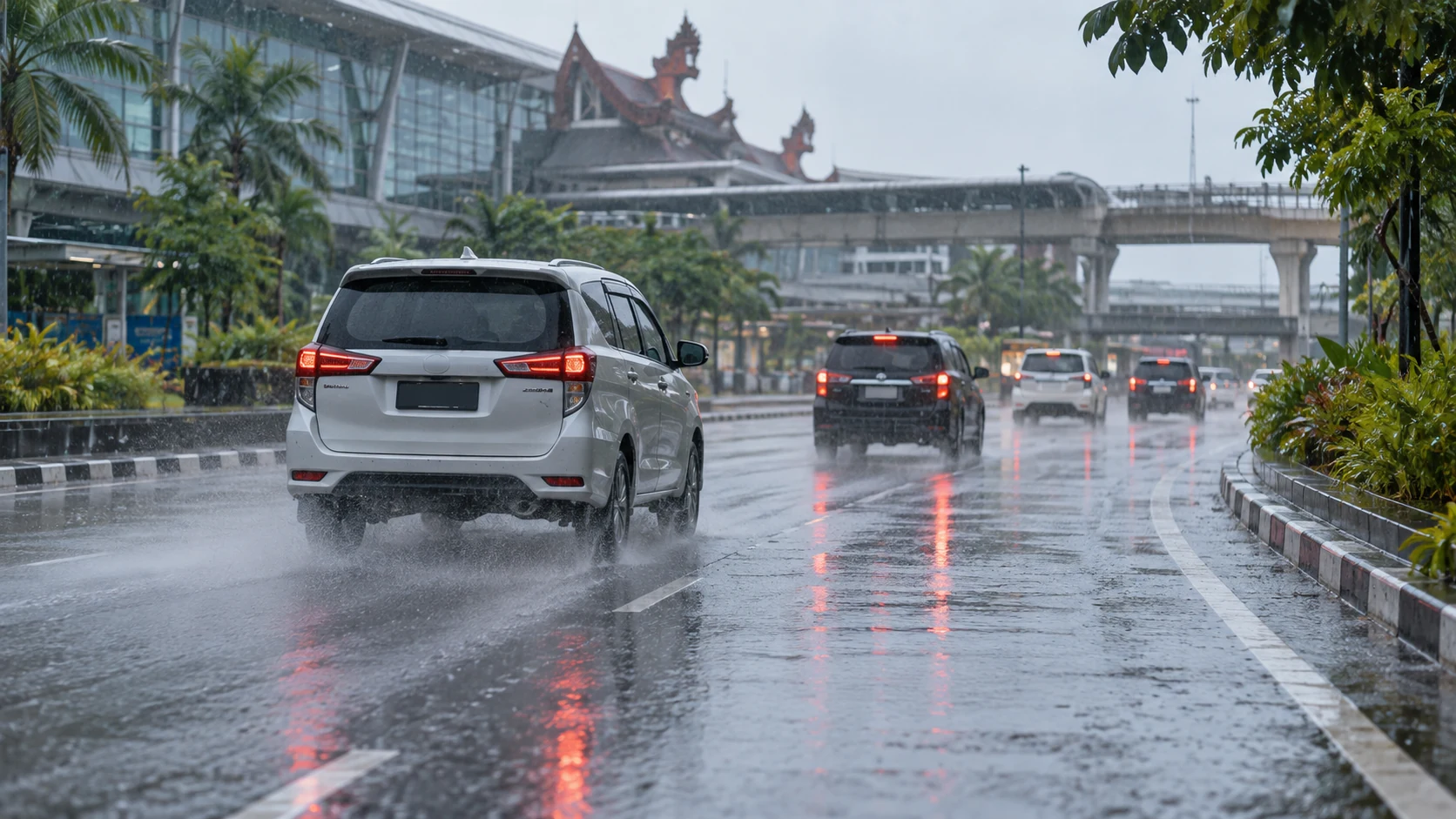
A rainy-season Bali itinerary works better when the backup plan is decided before you need it.
For your arrival day, identify one or two alternatives that do not depend heavily on dry weather.
For example, if your original plan is an outdoor sunset activity, decide in advance what you will do if heavy rain continues. This could be an indoor attraction, a meal or simply moving the activity to another day.
The same principle applies to transport.
If your route normally includes a particular stop, viewpoint or outdoor destination, do not make the transfer dependent on completing that stop. Reach the accommodation first, then decide what remains practical.
A simple Bali rainy-season airport transfer checklist
Before departure:
- Confirm your flight number and arrival date.
- Confirm the arrival terminal.
- Save the driver’s contact details.
- Confirm the pickup instructions.
- Pack waterproof protection for important belongings.
- Keep passports and essential documents in hand luggage.
- Check the current weather outlook close to travel day.
- Check traffic conditions when practical.
- Avoid tightly scheduled activities immediately after arrival.
- Have a flexible alternative for your first planned activity.
After landing:
- Complete the required airport arrival procedures.
- Collect your luggage.
- Keep important belongings protected if it is raining.
- Follow the agreed pickup instructions.
- Contact the driver when you are ready to leave the arrival area.
- Allow the road journey to take longer if conditions require it.
- Reassess your first activity after reaching your accommodation.
Plan flexibility into your rainy-season arrival
A Bali rainy-season airport transfer is mainly about managing uncertainty.
Rain may affect traffic, the pickup environment, luggage handling and plans after reaching your destination. You cannot control those conditions, but you can make the arrival easier by confirming the pickup process, protecting your luggage, keeping communication details accessible and leaving flexibility around your first activity.
Before travelling, check current weather and traffic information rather than relying on a long-range assumption. Then arrange your airport transfer with your destination, arrival procedures and post-transfer plans in mind.
If you are ready to arrange your airport pickup, review the transfer details in advance and make sure the meeting point, passenger information and communication method are clear before your flight.

Frequently Asked Questions
Is Bali rainy season a problem for airport transfers?
Not necessarily. Airport transfers continue during wet weather, but rain can affect traffic, walking conditions and luggage handling. The practical response is to allow flexibility rather than assume a fixed journey time.
What should I do if it is raining when I land in Bali?
Follow the airport’s arrival process, collect your luggage and use the agreed pickup instructions. Keep valuables and important documents protected, then contact your driver according to your booking instructions.
Can rain delay a Bali airport transfer?
Yes. Rain can contribute to slower traffic and changing road conditions, although the effect varies by location, time of day and the intensity and duration of rainfall. A specific delay cannot be predicted reliably in advance.
Should I book an activity immediately after landing?
Avoid making an important time-sensitive activity dependent on an exact airport-to-hotel arrival time. A flexible meal, hotel downtime or activity near your accommodation gives you more room to adapt if the transfer takes longer.
How can I protect my luggage during a rainy airport pickup?
Use waterproof covers or bags where appropriate, keep electronics and documents protected inside your hand luggage, and avoid leaving sensitive items exposed while moving from the terminal to the vehicle.
Should I contact my driver if my flight is delayed?
Yes. If your flight schedule changes significantly, use the agreed contact method to update the transfer provider. After landing, another useful update is when you have collected your luggage and are ready to leave the arrival area.