
If you are looking for the best temples in Bali, you have come to the right place. One of the most popular destinations in Bali is its temples. Bali is home to more than 20,000 temples, ranging from towering mountain shrines to sea-cliff sanctuaries, each one telling its own story of devotion, legend, and Balinese artistry.
In this complete guide, we have handpicked 20 of the most sacred and stunning temples in Bali, organized by area, with ticket prices, opening hours, and insider tips so you can plan your visit with confidence

What Are the Must-Visit Temples in Bali?
Bali is famous for its temples as centers of Hindu worship and symbols of culture on this island of the gods. Although they are centers of spirituality, Bali’s temples also have their own tourist charm. Many tourists want to know more about the temples.
Each temple has its own story and unique architecture that differs from one another. Some temples are hidden away, such as in the middle of a forest, and there are even some in the middle of the sea. So, which temples should you visit while in Bali?
As a tour guide, I have a list of best temples in Bali that are worth visiting. Here are some of Bali temples:
Best Temples in East Bali
East Bali, dominated by the looming presence of Mount Agung, is home to Bali’s most sacred and historically significant temple complex. This region is the spiritual heartland of Balinese Hinduism, and a visit here feels noticeably more profound and less touristic than other areas.

Bali’s Mother Temple – Besakih Temple
Known as the Mother Temple of Bali, Besakih Temple is the largest, holiest, and most important temple complex on the island. Located on the slopes of Mount Agung (Karangasem), it is one of the largest Hindu spiritual centers in Bali. Besakih Temple, or the “Mother Temple,” has Penataran Agung as its central temple and a total of 46 temples in the complex.
Because it is located at an altitude of around 1,000 meters above sea level, you can enjoy the cool air upon arrival at the temple area. You can also easily see Mount Agung from here. The temple grounds welcome visitors daily from 7:00 AM to 6:00 PM, and the complex closes entirely during Nyepi, the Balinese Day of Silence.
Either morning or afternoon is the best time to come to Besakih Temple. The earlier in the morning and later in the afternoon, the better, as it will be less crowded. The entrance fee includes a mandatory local guide, sarong rental, and shuttle ride, so you do not need to hire a separate guide.
- Besakih, Rendang, Karangasem, Bali | Ticket: IDR 150,000 (includes local guide, sarong, and shuttle) | Hours: 07:00-18:00 | Best time: early morning before the mist rises
The Gates of Heaven in Bali – Lempuyang Luhur Temple
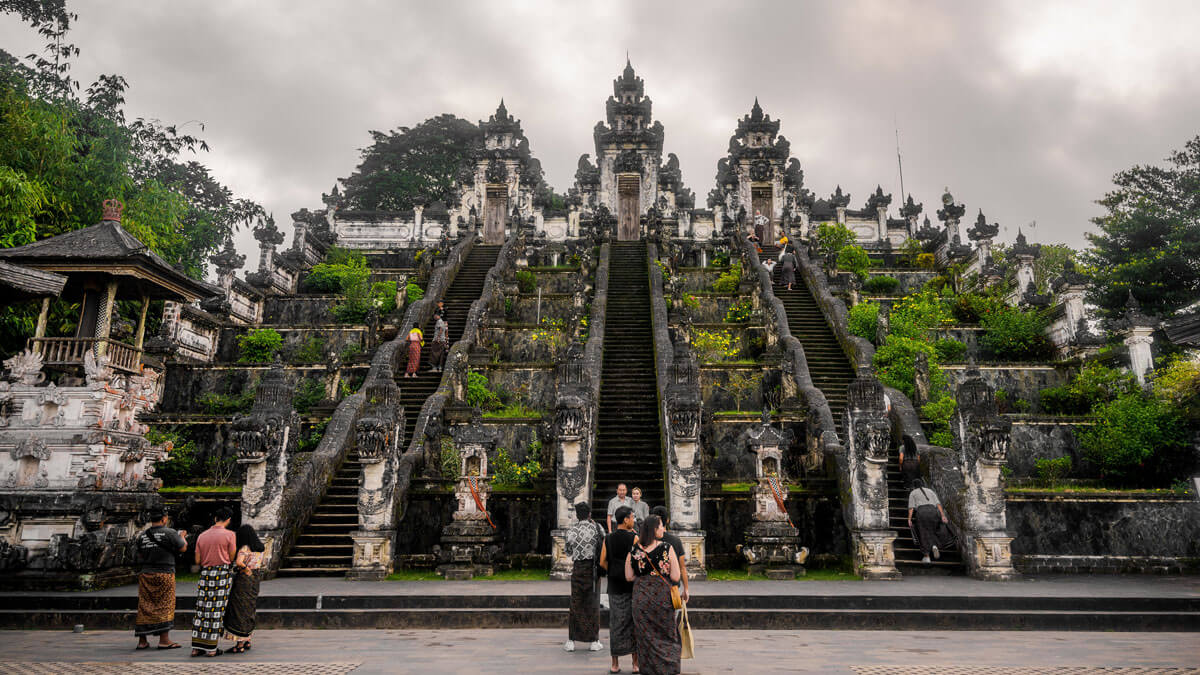
One of Bali’s oldest and most sacred temples, Lempuyang Temple is not only as one of the best temples in Bali, but also one of the most photographed, thanks to the stunning Gates of Heaven (Candi Bentar) framing a perfect view of Mount Agung on clear days. Lempuyang Luhur Temple, which is also located in the Karangasem area in eastern Bali. Here, you can also see the view of Mount Agung. Prepare yourself physically because you will need to climb a fairly steep path.
There are at least 7 temples that you can explore in about 4 hours, depending on how fast you are. For the first one, it’s only a 5-minute walk. For a more comfortable exploration, a shuttle is available for IDR 45,000.
The entrance fee is IDR 30,000. You can visit Lempuyang Temple from 6 a.m. and leave before 7 p.m. What should you keep in mind if you want to visit Lempuyang Temple?
Make sure you wear clothing that covers your shoulders because if you don’t, you will not be allowed to enter. You can use a scarf to cover your shoulders if you are wearing sleeveless clothing. In the Lempuyang temple area, you are also not allowed to record with a drone or kiss.
- Tri Buana, Abang, Karangasem, Bali | Ticket: IDR 30,000 | Hours: 06:00-19:00 | Best time: 06:00-08:00
Goa Lawah Temple – The Sacred Bat Cave of Klungkung
One of Bali’s nine directional temples, Goa Lawah Temple is built at the mouth of a cave that is home to tens of thousands of sacred fruit bats, making it one of the most unusual and memorable sacred sites on the island. The cave entrance behind the main shrine is alive with the fluttering of bats, and according to Balinese Hindu belief, the cave is said to run all the way to the inner sanctuary of Besakih Temple, miles away on the slopes of Mount Agung.
Located on the coastal road between Klungkung and Padangbai, Goa Lawah is conveniently positioned for travelers heading to East Bali or the Amed diving area. Dress respectfully and observe the rules of the complex. The best time to visit is just before dusk, when the bats begin to emerge in swirling clouds against the sky, creating a spectacular natural sight.
- Pesinggahan, Dawan, Klungkung, Bali | Ticket: IDR 15,000 | Hours: 08:00-18:00 | Best time: late afternoon before sunset
Kehen Temple – Terraced State Temple of the Bangli Kingdom
Built into a hillside in Bangli town, Kehen Temple is the state temple of the former Bangli Kingdom and one of the most architecturally impressive temples in Bali. The temple rises in a series of eleven terraced courtyards, ascending from an impressive split gate guarded by mythological figures up to the sacred inner sanctuary at the summit. Ancient stone inscriptions found at the site date the temple to at least the 9th century.
Despite its grandeur and historical significance, Kehen Temple remains refreshingly uncrowded compared to more commercially prominent temples, making it a genuine discovery for independent travelers. The climb through the terraced courtyards offers increasingly beautiful views over the Bangli valley. Combining a visit here with the nearby Penglipuran Traditional Village makes for an excellent and authentic day trip from Ubud.
- Cempaga, Bangli, Bali | Ticket: IDR 15,000 | Hours: 08:00-18:00 | Best time: morning
Best Temples in Ubud and Gianyar
The Ubud and Gianyar regency is the cultural heartland of Bali, and nowhere is this more apparent than in its extraordinary concentration of ancient temples. From holy spring purification sites to rock-cut royal tombs, this area contains some of the most historically and spiritually profound best temples in Bali.

Spiritual Cleansing at Tirta Empul (Tampak Siring) Temple
This temple, famous for its holy water, has 30 stone waterspouts across its purification pools for soul cleansing ceremonies. Tirta Empul Temple has natural springs that are believed to be able to cure poison in the Warmadewa Dynasty era. Located in Gianyar, this temple is open daily from 8:00 AM to 6:00 PM. For the full visitor experience, including the melukat ritual step by step, see our complete Tirta Empul guide.
The entrance fee is IDR 75,000 for international adults and IDR 50,000 for children aged 5 to 12, with children under 5 admitted free. Like other temples, Tirta Empul is a sacred temple that is the center of the Hindu community. To enter the area, you must wear a sarong.
If you don’t have a sarong, Tirta Empul temple provides shawls and sarongs. Do not wear revealing clothing that shows your knees and shoulders. Visitors are also not allowed to kiss or engage in other indecent activities in the Tirta Empul area.
You can take photos and videos with a camera, but do not use a drone. Tirta Empul has complete facilities to support visitor comfort, including changing rooms, toilets, lockers, and a parking area. When is the best time to visit Tirta Empul? It depends on your preference, but around 9 a.m. is usually quiet.
- Manukaya, Tampaksiring, Gianyar, Bali | Ticket: IDR 75,000 (adult) / IDR 50,000 (child 5-12) | Hours: 08:00-18:00 | Best time: 07:00-09:00
Goa Gajah Temple – The Ancient Elephant Cave
Goa Gajah Temple is one of Bali’s most fascinating archaeological sites, featuring a carved rock-face entrance in the shape of a demonic face that opens into a cave sanctuary used for meditation and spiritual practice. Dating to the 9th century, the cave contains a Shivalinga and statues of Ganesha within its dark interior, surrounded by intricate carvings of demons, animals, and divine figures.
Outside the cave, a beautiful bathing pool complex features six elaborately carved water spouts, a stunning example of ancient Balinese-Hindu artistry. Steps lead down into the lush river valley, where you can explore additional shrines and a small stream. Arriving early in the morning gives you the complex in peaceful quiet, with the carved stone illuminated by soft light filtering through the surrounding trees.
- Bedulu, Blahbatuh, Gianyar, Bali | Ticket: IDR 30,000 | Hours: 08:00-17:00 | Best time: 08:00-10:00
Gunung Kawi Temple – Ancient Rock-Cut Royal Tombs
Carved directly into the face of a cliff rising from the Pakerisan River valley in Tampaksiring, Gunung Kawi Temple is one of Bali’s most impressive and least-crowded ancient monuments. The complex features a series of 10 rock-cut royal shrines dating to the 11th century during the reign of King Anak Wungsu, each standing about 7 meters tall and framed by an ornately carved niche.
To reach the temple, visitors descend a steep staircase of around 300 steps through a dramatic canyon of overhanging rock and jungle vegetation. The river valley at the bottom is cool and verdant, with rice fields and small shrines dotting the landscape. Good walking shoes are essential, and the climb back up is a workout but entirely worth it.
- Tampaksiring, Gianyar, Bali | Ticket: IDR 50,000 | Hours: 07:00-17:00 | Best time: 07:00-09:00
Pura Taman Saraswati – The Lotus Temple in the Heart of Ubud
Sitting in the heart of Ubud town, Pura Taman Saraswati is dedicated to Saraswati, the Hindu goddess of knowledge, arts, and wisdom, making it a deeply fitting temple for Bali’s artistic capital. The temple is framed by an enormous lotus pond filled with blooming pink and white lotus flowers, and the elaborately carved red-brick entrance gate together form one of Ubud’s most iconic images.
In the evenings, the temple hosts traditional Balinese dance performances including the Legong dance, set against the glowing facade of the temple. The adjacent Cafe Lotus offers beautiful views over the lotus pond if you would like to linger. Visit in the early morning for quiet reflection, or in the evening for the dance performances.
- Jl. Kajeng, Ubud, Gianyar, Bali | Ticket: Free (donation) | Hours: 08:00-18:00 | Best time: 07:00-08:00 or 18:00 for dance show
Batuan Temple – Ancient Village Temple with Centuries of History
With origins dating back nearly a thousand years to the 10th century, Batuan Temple is one of the oldest temples in Bali. Located in the village of Batuan in Gianyar, the same village renowned for its distinctive dark-ink painting style, this temple complex is remarkable for the density and intricacy of its stone carvings depicting scenes from Hindu mythology. The moss-covered walls and towering split gates give the temple a dramatically ancient atmosphere.
Unlike more heavily visited temples, Batuan offers a genuinely authentic glimpse into the religious and artistic life of a traditional Balinese village community. The complex is still actively used for ceremonies and worship, so visitors may occasionally witness temple preparations, offerings, or full ceremonial processions. Be respectful and keep voices low when ceremonies are in progress.
- Batuan, Sukawati, Gianyar, Bali | Ticket: IDR 15,000 (donation) | Hours: 08:00-18:00 | Best time: morning
Gunung Kawi Sebatu Temple – Lush Water Temple in the Gianyar Hills
Set amidst tropical gardens and tiered rice terraces in the highlands of Gianyar near Tegallalang, Gunung Kawi Sebatu is centered around several crystal-clear natural spring pools teeming with colorful fish, surrounded by immaculately carved stone shrines draped in yellow and white temple cloth. The setting is lush, green, and wonderfully quiet, making it one of the most peaceful temples in Bali.
The temple is used for melukat purification rituals and is actively maintained as a place of worship, lending it a genuine spiritual atmosphere. Koi fish fill the cool spring pools, and the sound of running water pervades the entire complex. This is an excellent temple to visit if you are already in the Ubud area and want to escape the crowds. Bring a sarong, which is required for entry.
- Sebatu, Tegallalang, Gianyar, Bali | Ticket: IDR 15,000 | Hours: 08:00-17:00 | Best time: 08:00-10:00

Best Temples in South Bali (Uluwatu and Badung)
The Bukit Peninsula and Badung regency are home to some of the most dramatic temple settings on the island, with shrines perched on clifftops and nestled inside monkey forests. If you are staying in Seminyak, Kuta, or Nusa Dua, these are the most accessible temples in Bali to visit.
Uluwatu Temple – Clifftop Sunset and Kecak Fire Dance
One of Bali’s six spiritual pillars (Sad Kahyangan), Uluwatu Temple is perched dramatically on a 70-meter cliff at the southwestern tip of the Bukit Peninsula. Dedicated to the spirits of the sea, Pura Luhur Uluwatu is considered one of the holiest temples in Bali and draws visitors not only for its spiritual significance but for its breathtaking position above the crashing Indian Ocean. The temple dates back to the 11th century.
Every evening at sunset, the temple hosts a mesmerizing Kecak Fire Dance performance set against the dramatic cliff backdrop, arguably one of the most iconic experiences you can have in Bali. Beware of the resident monkeys, which are sacred but known to snatch sunglasses, phones, and bags. The best time to visit is late afternoon, arriving around 5 PM for sunset views and the 6 PM Kecak performance.
- Pecatu, Kuta Selatan, Badung, Bali | Ticket: IDR 50,000 | Hours: 07:00-19:00 | Best time: 17:00-19:00 (sunset and Kecak)
Best Temples in Tabanan and West Bali
Tabanan and the western regencies of Bali offer some of the island’s most scenic and spiritually significant temples, from iconic sea temples to mountain forest shrines. This area is perfect for a day trip from Seminyak or Canggu.
Meeting the Sea God at Tanah Lot Temple
This temple is different from other temples in Bali because it is located in the middle of the sea. You can have a spiritual experience, learn about Hindu traditions, and enjoy the beauty of Bali. At high tide, Tanah Lot temple appears to be floating.
This temple is located on large rocks, which makes it look magnificent. At sunset, the view of Tanah Lot Temple is truly breathtaking. You can also visit Goa Ular Suci, where sacred sea snakes are considered the guardians of this temple according to local beliefs.
Tanah Lot temple is so crowded with visitors that many facilities are available. Facilities around this temple include a large parking area, toilets, an information center, a place of worship, restaurants, and souvenir shops. In the art shop, you can buy wood carvings, accessories, paintings, sandals, Balinese sarongs, hats, and T-shirts.
- Beraban, Kediri, Tabanan, Bali | Ticket: IDR 60,000 | Hours: 07:00-19:00 | Best time: 17:00-19:00 (sunset)
Taman Ayun Temple – Royal Water Garden of the Mengwi Kingdom
The royal state temple of the former Mengwi Kingdom, Taman Ayun Temple is one of the most architecturally elegant temples in Bali. Built in 1634 and later renovated in 1937, the temple sits on a small island surrounded by a wide moat, earning it the poetic name Garden Temple in the Water. The towering multi-tiered meru shrines reflected in the still waters of the surrounding moat create a scene of serene majesty.
As a UNESCO World Heritage cultural landscape, Taman Ayun is impeccably maintained and offers a peaceful, uncrowded alternative to busier temples. Visitors can stroll the outer gardens and the moat perimeter, admiring the intricate stone carvings and lush tropical surroundings. The inner temple courtyard is reserved for Balinese Hindu worshippers. A small museum on-site provides historical context about the Mengwi Kingdom.
- Mengwi, Badung, Bali | Ticket: IDR 20,000 | Hours: 08:00-18:00 | Best time: 08:00-10:00
Pura Luhur Batukaru – Sacred Mountain Temple in the Cloud Forest
One of Bali’s nine directional temples (Sad Kahyangan), Pura Luhur Batukaru sits at the foot of Mount Batukaru, Bali’s second-highest volcano, deep within a pristine rainforest. At an elevation of around 800 meters, the temple is often shrouded in cool mist, lending it an ethereal atmosphere that few temples in Bali can match. Dedicated to Mahadewa, the spirit of Mount Batukaru, this temple holds immense spiritual importance for the Balinese people.
The surrounding rainforest is alive with birds, insects, and the sound of rushing water from nearby streams, making the journey to the temple as rewarding as the destination. The complex features a beautiful lotus pond, tiered shrines, and ancient stone carvings that speak to centuries of continuous worship. Bring a light jacket as temperatures here can drop noticeably compared to the coast.
- Wongayagede, Penebel, Tabanan, Bali | Ticket: IDR 30,000 | Hours: 08:00-17:00 | Best time: 07:00-09:00
Alas Kedaton Temple – Sacred Monkey Forest Sanctuary
Tucked inside a dense banyan tree forest in Tabanan, Alas Kedaton Temple is beloved by both spiritual pilgrims and wildlife enthusiasts. The temple is home to hundreds of sacred macaque monkeys and large fruit bats that hang from the ancient trees overhead, creating an otherworldly atmosphere that sets it apart from other temples in Bali. The temple itself is dedicated to Siwa and Brahma and features intricately carved stone gateways and shrines draped in moss.
The forested path leading to the temple is itself part of the experience, as you walk beneath a canopy of towering banyan trees alive with the chatter of monkeys. Local guides are available at the entrance and can help you navigate the complex safely, especially if you are visiting with children. The monkeys are bold but generally harmless if you do not provoke them or show food. Come in the morning for the quietest and most atmospheric visit.
- Kukuh, Marga, Tabanan, Bali | Ticket: IDR 20,000 | Hours: 08:00-18:00 | Best time: 08:00-10:00
Rambut Siwi Temple – Coastal Cliff Temple of West Bali
Perched above a long black-sand beach with sweeping views of the Java Sea, Rambut Siwi Temple is a striking clifftop sea temple in Jembrana, West Bali. Like Tanah Lot, this temple is associated with the 16th-century Hindu priest Danghyang Nirartha, who is said to have enshrined a lock of his own hair here to protect the local people from plague, giving the temple its evocative name meaning revered hair. The complex consists of several shrines set into the cliffside, connected by stone pathways that wind above the ocean.
Because of its location on the western road between Denpasar and Gilimanuk, Rambut Siwi is often visited as a stop on the journey to West Bali National Park or the ferry to Java. However, the temple grounds are uncrowded and authentically atmospheric, and it more than justifies a dedicated visit for those interested in Bali’s spiritual heritage outside the main tourist routes. Visit in the late afternoon when the light turns golden over the sea.
- Yehembang, Mendoyo, Jembrana, Bali | Ticket: IDR 15,000 | Hours: 08:00-18:00 | Best time: 16:00-18:00
Best Temples in North and Central Bali
The north and central highlands of Bali offer a completely different temple experience with cooler air, volcanic lakes, ancient mountain shrines, and a quieter, more local atmosphere far from the southern tourist crowds.
Ulun Danu Beratan Temple – Floating Temple on Lake Beratan
One of the most iconic and recognizable temples in Bali, Ulun Danu Beratan Temple is a photogenic complex of multi-tiered shrines that appears to float serenely on the surface of Lake Beratan in the cool highlands of Bedugul, Tabanan. Dedicated to Dewi Danu, the goddess of water, lakes, and rivers, this temple is one of the most important agricultural temples in Bali, as the waters of Lake Beratan feed the irrigation systems sustaining rice cultivation across a large portion of the island.
The surrounding Bedugul area is lush and misty, sitting at an elevation of approximately 1,240 meters above sea level. The temple complex includes a Buddhist stupa alongside the Hindu shrines, reflecting Bali’s pluralistic spiritual tradition. Arrive at sunrise for the best photography and the calmest atmosphere before morning tour groups arrive. Rowing boats and paddle boats are available on the lake if you would like to view the temple from the water.
- Candi Kuning, Baturiti, Tabanan, Bali | Ticket: IDR 50,000 | Hours: 07:00-19:00 | Best time: 07:00-08:00 (sunrise)
Puncak Penulisan Temple – Bali’s Highest Ancient Temple
Sitting atop Bukit Penulisan at approximately 1,745 meters above sea level on the rim of the ancient Batur caldera in Kintamani, Puncak Penulisan Temple is Bali’s highest-elevation ancient temple. This rarely visited hilltop temple rewards those who make the effort with extraordinary panoramic views over Mount Batur, Lake Batur, and Mount Agung, and on clear days all the way to the north coast of Bali.
The temple complex houses a remarkable collection of ancient stone statues and inscribed tablets dating back to the 11th century, making it one of Bali’s most important archaeological sites. Because of its remote and elevated location, Puncak Penulisan sees very few tourists, and the atmosphere is genuinely sacred and undisturbed. Combine the visit with a stop at nearby Kintamani for the famous caldera views.
- Sukawana, Kintamani, Bangli, Bali | Ticket: IDR 15,000 | Hours: 08:00-17:00 | Best time: morning (before mist rises)
Ponjok Batu Temple – The Hidden Cliff Temple of North Bali
Built into a dramatic rocky outcrop where a freshwater spring emerges from the clifftop and cascades directly into the sea below, Ponjok Batu Temple is a stunning sea-cliff temple located in the northern coastal regency of Buleleng. The temple is associated with Danghyang Nirartha, the same revered 16th-century Hindu priest connected to Tanah Lot and Rambut Siwi, completing a trio of coastal temples linked to his legendary pilgrimage around Bali.
Because of its location in North Bali far from the main tourist circuit, Ponjok Batu is visited almost exclusively by Balinese pilgrims and the most adventurous of travelers, making it one of the most authentically atmospheric temple experiences available. The combination of the freshwater spring, the rocky coastline, and the ornate temple shrines makes this one of the most visually unique temples in Bali. Best visited as part of a full North Bali day trip that also includes Gitgit Waterfall and Lovina Beach.
- Tembok, Tejakula, Buleleng, Bali | Ticket: IDR 10,000 | Hours: 08:00-17:00 | Best time: morning
Temples in Nusa Penida
The island of Nusa Penida, southeast of the Bali mainland, is famous for its dramatic scenery. It also harbors one of the most extraordinary and unusual temples in the entire Balinese Hindu tradition.
Goa Giri Putri Temple – The Sacred Cave Temple of Nusa Penida
Hidden inside a massive limestone cave in the hills of Nusa Penida, Goa Giri Putri Temple is accessible through a small and extremely narrow entrance hole in the rock face that requires visitors to bend down to pass through, a humbling act of spiritual submission before entering the sacred space within. Inside, the space opens up into a vast cavern containing multiple shrines, sacred springs, and altars, illuminated by natural light filtering through cracks in the rock and candles offered by worshippers.
The temple is dedicated to Dewi Suci, the goddess of purity, and is one of the most important temples for the Hindu community of Nusa Penida. The cave experience is genuinely awe-inspiring: the scale of the interior, the smell of incense, and the sounds of prayers echoing through the cavern create a deeply moving spiritual encounter unlike anything else in Bali. Because Nusa Penida requires a short boat crossing from Sanur or Kusamba, plan this as a full-day island excursion.
- Karangsari, Nusa Penida, Klungkung, Bali | Ticket: IDR 10,000 | Hours: 08:00-17:00 | Best time: morning

Frequently Asked Questions About Best Temples in Bali
What should I wear when visiting a Bali temple?
You must wear clothing that covers your knees and shoulders. At Bali temples, sarongs, shawls, or similar items are usually available for you to borrow or rent at the entrance.
What are the most famous temples in Bali?
The most iconic temples in Bali include Tanah Lot, Uluwatu, Besakih, Lempuyang, Tirta Empul, and Ulun Danu Beratan, all of which are featured in this guide.
Is the Tirta Empul temple worth visiting?
Yes, Tirta Empul is a holy spring temple with beautiful architecture and deep sacred values. You can participate in a melukat purification ceremony with water flowing through 30 sacred stone waterspouts.
Which temple in Bali is the most sacred?
Besakih Temple, known as the Mother Temple, is the largest and most sacred temple in Bali. It serves as the supreme spiritual center of Balinese Hinduism and hosts major island-wide religious ceremonies throughout the year.
How many temples are there in Bali?
Bali is estimated to have more than 20,000 temples of various sizes, from grand state temples to small family shrines (sanggah) found in almost every Balinese household.